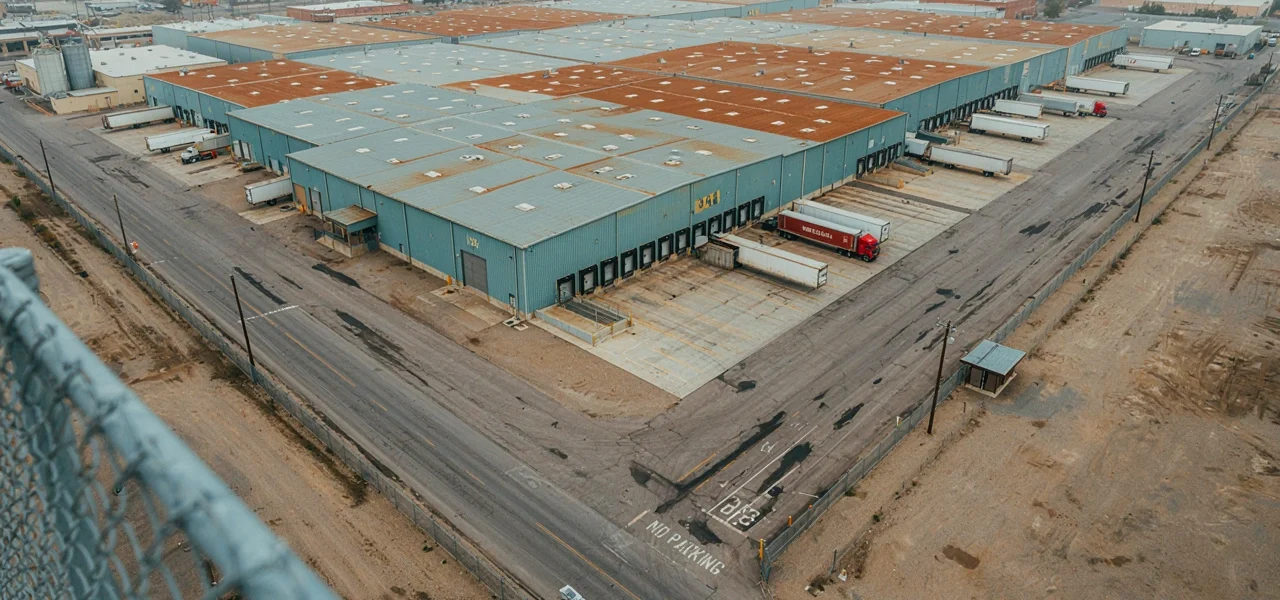
When industrial and logistics businesses rationalise their property portfolios, the decision is rarely as simple as “keep or sell”. For many owner-occupiers, a third option deserves closer consideration: sell the property, retain the operation and release the capital.
Industrial real estate can be one of the most valuable assets a business owns. It can also be one of the most overlooked when management teams review how capital is allocated.
A warehouse, production facility or distribution centre may have appreciated substantially over the years, while the business operating from it has changed. The company may be expanding, consolidating sites, investing in automation, pursuing acquisitions or adapting its supply chain. The property remains operationally important. But does it still need to be owned?
That is the decision at the heart of Sale and Leaseback.
Start with the business, not the building
The most useful way to approach portfolio rationalisation is not to begin with the question of which properties should be sold. Start with the business strategy.
Where does the company need to operate over the next five, ten or fifteen years? Which facilities are genuinely critical? Which locations are becoming inefficient? Where is additional capital needed? And which properties are valuable primarily because the business happens to own them?
These questions can lead to three broad outcomes.
- Some properties should be retained because ownership remains strategically important
- Some should be sold because the business no longer needs the location
- And some sit in the middle: the business still needs the facility, but may no longer need to own it
That third category is where Sale & Leaseback can become a compelling option.
Five signals that it may be time to consider Sale & Leaseback
There is no single reason for an owner-occupier to pursue a Sale & Leaseback. Usually, the opportunity emerges when several strategic factors come together.
1. The property is valuable, but the capital could be more valuable elsewhere
The first question is perhaps the most important: What is the opportunity cost of the capital tied up in the property?
An industrial facility can represent significant equity. If that capital is sitting in bricks and mortar while the business is looking to fund expansion, acquisitions, automation or other strategic investments, ownership may not be the most efficient use of the company’s resources.
A Sale & Leaseback converts part of that illiquid real estate value into capital while allowing the business to remain operational at the property. The decision should therefore not be based solely on the property’s market value. It should be based on what the business could do with the capital released from it.
2. The business still needs the building but not necessarily forever
Long-term operational need does not automatically mean long-term ownership is necessary. A company may expect to operate from a facility for another 10 or 15 years but have little strategic reason to own the underlying real estate for that entire period.
This is particularly relevant for owner-occupiers with mature, established facilities. If the business has a clear operational requirement but does not need ownership control, a Sale & Leaseback can separate the two decisions.
The company retains the location. The investor takes ownership. That can provide certainty for the occupier while creating a long-term investment opportunity for the buyer.
3. The portfolio is becoming too complex
Portfolio rationalisation often follows years of organic growth, acquisitions or geographic expansion. A business may have accumulated multiple facilities that made sense individually but are no longer optimal as a portfolio.
Perhaps operations can be consolidated. Perhaps some sites are underutilised. Perhaps newer facilities are taking over functions previously spread across several buildings. This is when management should look at each asset through two lenses:
Is this property strategically important to our operations?
and
Is owning this property strategically important to our business?
Those questions may produce different answers. A property that remains essential operationally can potentially be monetised through Sale & Leaseback rather than being treated as an asset that must automatically remain on the balance sheet.
4. Relocation would destroy more value than it creates
Selling an industrial facility is not always straightforward.
For a logistics or manufacturing occupier, relocation can involve significant costs and operational risks. A suitable alternative may not be available nearby. Customer service levels can be affected. Transport routes can change. Employees may be impacted. Planning, permitting and power availability can introduce further complications.
This is particularly relevant in the Netherlands, where strategic logistics locations face constraints around land, infrastructure and electricity capacity. If the location works operationally, selling the property and moving simply to release capital may make little sense.
A Sale & Leaseback offers another route: monetise the property without necessarily moving the business.
5. The property has become more valuable than its original purpose suggests
Many industrial properties have evolved alongside the businesses occupying them. A facility acquired decades ago may now sit in an established logistics location with strong connectivity and limited availability of comparable sites.
The business may see it primarily as a workplace or distribution facility.
The investment market may see something different: a well-located industrial asset with a strong occupier and long-term income potential. That difference in perspective can create an opportunity.
Portfolio rationalisation is therefore not only about identifying non-core properties. It is also about identifying properties whose financial value has become disproportionately high relative to their strategic ownership value.
The Netherlands makes the decision particularly relevant
These considerations are playing out against a changing Dutch and European industrial real estate market. The Netherlands remains a critical logistics gateway to Europe, with established industrial and logistics clusters around Rotterdam, Venlo, Tilburg-Waalwijk, Eindhoven, Moerdijk and other strategic locations.
But the market is becoming increasingly selective. Occupiers are looking for modern, efficient and future-ready facilities, while investors are placing greater emphasis on location quality, building functionality, tenant strength and long-term resilience. At the same time, European supply chains are being reshaped by geopolitical uncertainty, nearshoring and reshoring, automation and the need for greater resilience. Energy is becoming part of the real estate equation as well. Power availability can increasingly influence whether a location is capable of supporting automation, electrification and future operational requirements. All of this makes portfolio decisions more strategic. An occupier cannot simply ask whether it owns “too much” real estate. It needs to ask whether its current portfolio supports where the business is going.Sale & Leaseback is not simply a property sale
This distinction matters. A traditional disposal asks:
“What price can we achieve for this property?”
A strategic Sale & Leaseback asks several additional questions:
- How much capital can we release?
- How long do we need to occupy the property?
- What lease structure gives the business sufficient operational certainty?
- What will the business do with the released capital?
- Does ownership still create strategic value?
- Does the property have the fundamentals that make it attractive to a long-term investor?
The answers determine whether a Sale & Leaseback creates value. The objective is therefore not simply to maximise the property’s sale price. It is to find the right balance between capital released, operational certainty and long-term business strategy.
The decision should not be “sell or don’t sell”
For an owner-occupier reviewing its portfolio, there is a more useful framework:
| Strategic Question | Potential Direction |
| Is the property essential to future operations? | Consider retaining or Sale & Leaseback |
| Is the property no longer operationally required? | Consider a conventional disposal |
| Is the location strategically important but capital is needed elsewhere? | Consider Sale & Leaseback |
| Is the facility becoming inefficient or obsolete? | Consider relocation or disposal |
| Is the property highly valuable but ownership adds limited strategic value? | Consider Sale & Leaseback |
| Is the business pursuing M&A, expansion or major investment? | Assess whether real estate capital could be redeployed |
| Is the property difficult to replace? | Evaluate whether Sale & Leaseback can preserve operational continuity |
This framework changes the conversation.
Instead of treating every asset as simply owned or sold, management can consider the property according to its operational role and capital role.
What should owners and occupiers consider before making the move?
A Sale & Leaseback should not be pursued simply because capital can be released.
The transaction needs to work for the business over the long term.
The occupier should consider the required lease term, rental economics, flexibility, future expansion requirements, maintenance responsibilities and any operational changes that may occur during the lease period.
The property itself also matters.
Location, building quality, tenant covenant, remaining economic life, sustainability characteristics, redevelopment potential and long-term market demand all influence investor appetite.
And perhaps most importantly, the business should have a clear answer to one question:
What will we do with the capital once it is released?
If the answer is growth, acquisitions, automation, debt optimisation or another clearly defined strategic objective, the case for Sale & Leaseback can become significantly stronger.
Where RENEW Real Estate fits
At RENEW Real Estate (RRE), we believe these decisions should begin with the underlying business and the role of the property within it.
RRE is a direct investor and acquirer of logistics and industrial real estate, with a focus on opportunities across the Netherlands and Europe. This includes direct acquisitions and Sale & Leaseback transactions where the property and the occupier’s requirements can support a long-term investment strategy.
For an owner-occupier, that means the first conversation does not need to be about putting a building on the market.
It can be about asking whether the property is still serving the business in the most effective way as both an operating asset and a capital asset.
In the right circumstances, RRE can acquire the property while the occupier continues operating from the facility under an agreed lease structure.
That can create a straightforward outcome:
- The business releases capital
- The occupier retains operational continuity
- The investor acquires a long-term industrial or logistics asset
A property review can uncover more than surplus space
Portfolio rationalisation is often approached as a cost exercise: fewer buildings, lower overheads, greater efficiency.
But it can also be a capital exercise.
The property portfolio may contain assets that are operationally important but financially underutilised. Those assets can potentially become a source of capital without requiring the business to abandon locations that remain critical to its operations.
For owners and occupiers across the Netherlands and Europe, the question is therefore becoming less about whether to own industrial real estate and more about which assets are worth owning, and why.
The answer will be different for every business.
But for companies with capital-intensive growth plans, changing portfolio requirements or valuable strategic locations, Sale & Leaseback deserves to be part of the conversation.
The decision to explore
If your business is currently reviewing its industrial or logistics portfolio, consider three questions:
- Do we need this property?
- Do we need to own this property?
- Could the capital tied up in it create more value elsewhere?
If the answers point in different directions, there may be a Sale & Leaseback opportunity worth exploring.
RENEW Real Estate works directly with owners and occupiers to evaluate industrial and logistics acquisition and Sale & Leaseback opportunities across the Netherlands.
Is your property essential to your operations, but could the capital tied up in it be better deployed elsewhere?
A Sale & Leaseback or acquisition could unlock that capital while allowing you to continue using the property. Share the opportunity with us to explore whether there could be a fit.