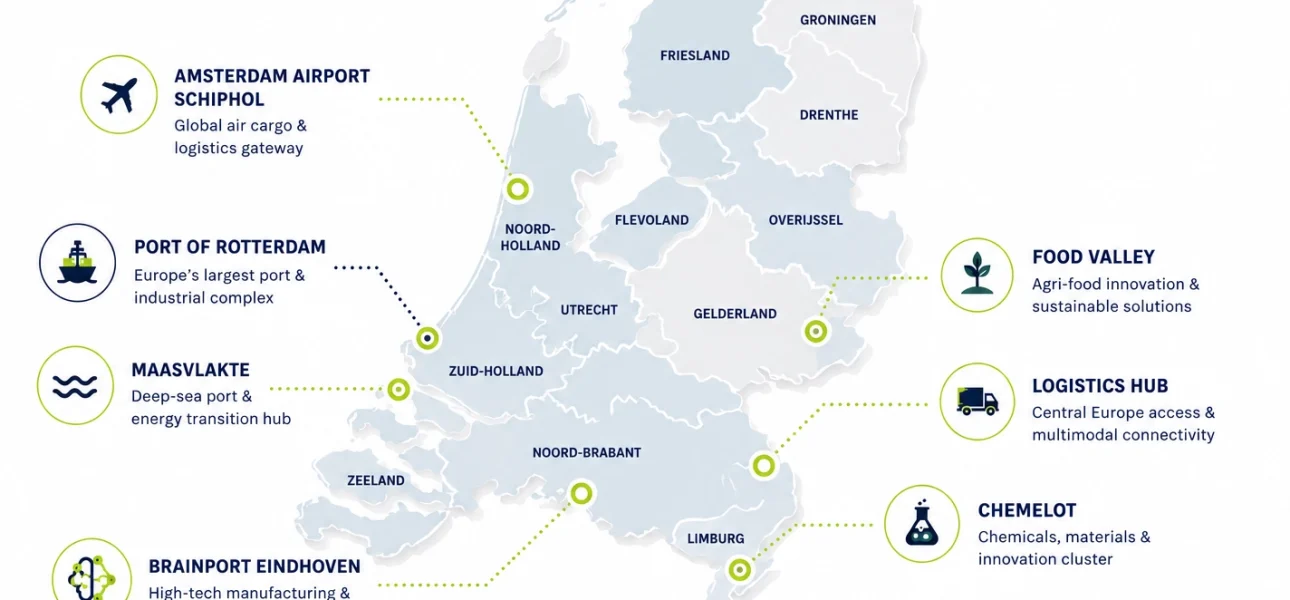
The Netherlands has long been recognised as one of Europe’s most strategic logistics hubs. Its central location, world-class transport infrastructure, and highly integrated supply chains continue to attract investors seeking resilient industrial and logistics real estate. Despite ongoing economic uncertainty, changing trade patterns, labour shortages, and stricter sustainability regulations, demand for high-quality logistics assets remains strong.
However, logistics investment is no longer concentrated solely around Rotterdam or Schiphol Airport. Today, investors are increasingly targeting regional logistics corridors that offer scalability, multimodal connectivity, ESG-ready developments, and access to skilled labour.
For industrial property owners, occupiers, and investors, understanding where capital is flowing provides valuable insight into future growth opportunities. At RENEW Real Estate (RRE), we closely monitor these regional investment trends to identify industrial and logistics assets that deliver long-term value while supporting the operational requirements of modern businesses.
Why the Netherlands Continues to Lead European Logistics
The Netherlands consistently ranks among Europe’s most attractive countries for logistics investment due to several competitive advantages:
- Strategic gateway to Europe
- Port of Rotterdam – Europe’s largest seaport
- Amsterdam Schiphol Airport
- Extensive motorway and rail infrastructure
- Inland waterways connecting major European markets
- Highly developed distribution ecosystem
- Strong digital and logistics technology adoption
More than 170 million consumers can be reached within a day’s drive from the Netherlands, making the country an ideal location for pan-European distribution networks.
As e-commerce continues to mature and supply chains evolve, investors increasingly favour locations that combine operational efficiency with long-term investment stability.
Venlo: Europe’s Cross-Border Logistics Powerhouse
Venlo remains one of the strongest logistics investment markets in the Netherlands.
Located close to the German border, Venlo provides direct access to Germany’s Ruhr region while serving as a strategic distribution gateway for Northern and Central Europe.
The region continues attracting:
- Third-party logistics providers (3PL)
- E-commerce fulfilment operators
- Manufacturing companies
- Consumer goods distributors
- International retailers
Demand for large-scale distribution centres remains particularly strong because occupiers value the region’s multimodal connectivity, skilled workforce, and availability of modern logistics facilities.
Investors continue to seek:
- High-bay warehouses
- Automated fulfilment centres
- Cross-dock facilities
- Built-to-suit logistics developments
Rotterdam-Rijnmond: Europe’s Logistics Capital
The Port of Rotterdam remains one of Europe’s most influential logistics investment locations.
Beyond maritime trade, Rotterdam has evolved into a highly integrated industrial and logistics ecosystem supporting:
- Container logistics
- Industrial manufacturing
- Chemical industries
- Cold chain logistics
- Bulk storage
- Distribution operations
The continued investment in port infrastructure, digitalisation, automation, and energy transition initiatives has strengthened investor confidence.
Industrial Outdoor Storage (IOS), logistics warehouses, and distribution centres close to the port remain highly attractive because they offer immediate access to international trade routes.
Growing investment in hydrogen infrastructure and sustainable industrial developments is also creating new opportunities for industrial real estate investors.
Moerdijk: Multimodal Logistics at Scale
Moerdijk has emerged as one of the Netherlands’ fastest-growing logistics corridors.
Its unique combination of:
- Deep-sea port access
- Inland shipping
- Rail freight
- Motorway connectivity
makes it highly attractive for companies seeking supply chain resilience.
Large distribution centres, manufacturing facilities, and logistics parks continue expanding across the region.
As European companies diversify supply chains and reduce dependence on single sourcing, Moerdijk’s strategic position between Rotterdam, Antwerp, and Germany has become increasingly valuable.
Institutional investors continue acquiring logistics assets capable of supporting long-term tenant demand.
Arnhem-Nijmegen: Growing Industrial Investment
The Arnhem-Nijmegen corridor has become increasingly attractive for industrial occupiers seeking lower occupancy costs while maintaining excellent accessibility.
The region offers:
- Strong motorway connections
- Cross-border access
- Modern industrial estates
- Skilled technical workforce
- Availability of development land
Manufacturing businesses, logistics operators, and advanced industrial companies continue relocating operations to this region.
Investors increasingly recognise its long-term growth potential as occupier demand expands beyond traditional logistics hotspots.
Breda: Southern Logistics Expansion
Breda continues strengthening its position as an important logistics hub in Southern Netherlands.
The city’s connectivity with Belgium, Rotterdam, Antwerp, and Germany supports a wide range of logistics operations including:
- Food logistics
- Retail distribution
- Manufacturing
- Pharmaceutical logistics
- Last-mile distribution
Growing occupier demand has encouraged developers to invest in modern, energy-efficient logistics facilities capable of meeting future ESG requirements.
Emerging Regional Investment Trends
Several broader trends continue reshaping industrial and logistics investment across the Netherlands and Europe.
ESG-Driven Investment
Sustainability has moved from being an added benefit to becoming an investment requirement.
Investors increasingly prioritise logistics assets incorporating:
- Solar PV systems
- Energy-efficient warehouses
- Electric vehicle charging
- Smart energy management
- BREEAM-certified developments
- Heat pumps
- Improved insulation
- Circular construction principles
ESG-compliant logistics facilities are achieving stronger investor demand while supporting future regulatory requirements.
Sale-and-Leaseback Activity Continues to Grow
Many industrial businesses continue unlocking capital through sale-and-leaseback transactions.
Rather than selling operational facilities and relocating, companies increasingly monetise owned real estate while remaining in occupation under long-term lease agreements.
This allows businesses to:
- Invest in automation
- Expand production capacity
- Finance acquisitions
- Improve working capital
- Accelerate business growth
Sale-and-leaseback continues to be one of the most active investment segments within Dutch industrial real estate.
Nearshoring and Supply Chain Resilience
European manufacturers are increasingly restructuring supply chains following years of disruption.
Instead of relying exclusively on distant production markets, businesses are investing closer to European consumers.
This trend continues increasing demand for:
- Distribution centres
- Urban logistics facilities
- Cross-dock operations
- Industrial Outdoor Storage (IOS)
- Manufacturing facilities
- Built-to-suit developments
The Netherlands remains one of the primary beneficiaries of this structural shift.
Automation and High-Bay Warehouses
Warehouse automation continues accelerating across Europe.
Occupiers increasingly require facilities capable of supporting:
- Automated Storage and Retrieval Systems (ASRS)
- Robotics
- AI-driven warehouse management
- Higher storage density
- Advanced picking technologies
As a result, modern high-bay warehouses and automation-ready logistics facilities continue attracting premium investor interest.
How RENEW Real Estate Identifies High-Potential Logistics Locations
At RENEW Real Estate (RRE), our investment approach is driven by long-term market fundamentals rather than short-term trends. We actively monitor the evolution of the Netherlands’ industrial and logistics landscape, identifying regions where infrastructure investment, occupier demand, sustainability initiatives, and supply chain developments create lasting value.
As an investor in industrial and logistics real estate, we evaluate each opportunity based on factors such as strategic location, multimodal connectivity, building quality, ESG performance, tenant strength, and future growth potential. This disciplined approach enables us to invest in assets that support both resilient business operations and long-term investment performance.
By combining local market knowledge with direct capital and efficient decision-making, RRE works closely with property owners to execute confidential acquisitions that align with the evolving needs of the Dutch and European logistics market.
The Future of Dutch Logistics Investment
The Dutch industrial and logistics real estate market continues to evolve alongside changing supply chains, sustainability objectives, and technological innovation. While established logistics hubs such as Rotterdam and Venlo remain key investment destinations, regions including Moerdijk, Arnhem-Nijmegen, and Breda are rapidly strengthening their position within Europe’s logistics landscape.
For property owners, this creates significant opportunities to unlock value through strategic asset sales, off-market transactions, or sale-and-leaseback structures. Investors, meanwhile, continue seeking well-located, future-ready logistics assets that align with long-term occupier demand and ESG expectations.
As these trends continue shaping the market, partnering with an experienced industrial real estate investor such as RENEW Real Estate (RRE) provides property owners with direct market insight, confidential transaction processes, and the expertise required to maximise the value of industrial and logistics real estate across the Netherlands.