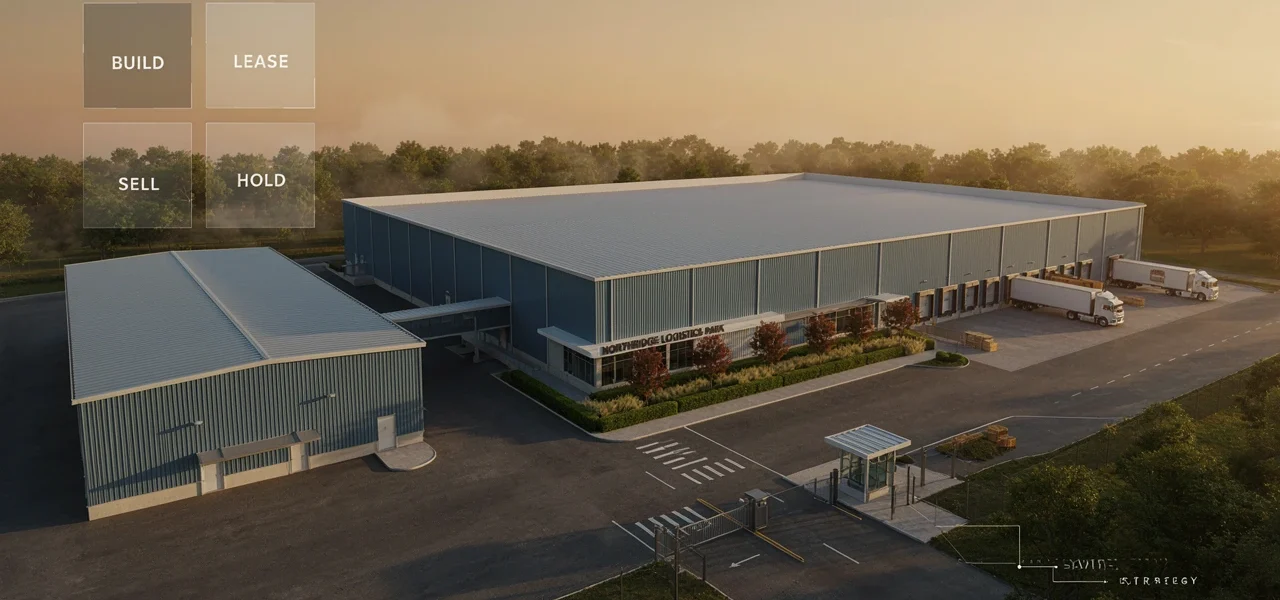
For owners and occupiers of industrial and logistics real estate, deciding what to do with a property can be as consequential as deciding where to invest next. Should you develop a new facility, lease an existing building, sell an asset, or retain it for long-term income and future value creation?
In the Netherlands and across Europe, limited development land, grid congestion, environmental permitting, changing occupier requirements and selective investment capital are reshaping how industrial property strategies are evaluated.
Evaluate your property’s potential with RENEW Real Estate’s Industrial & Logistics Property Strategy Planner to explore whether building, leasing, selling or holding best aligns with your strategic and financial objectives.
The objective is no longer simply to maximise the value of a building. It is to determine which strategy best aligns a property’s potential with operational requirements, capital priorities and long-term objectives.
1. Build: Create Value Through Development
Development can unlock substantial value when a site has the right location, planning potential and infrastructure. For businesses with specific operational requirements, a purpose-built facility can improve workflow, storage capacity, automation and distribution efficiency.
However, developing industrial and logistics real estate in the Netherlands requires careful assessment of land availability, planning permissions, construction costs, environmental requirements and access to electricity. Grid congestion and nitrogen-related restrictions can affect project feasibility and delivery schedules.
These constraints are encouraging greater interest in brownfield redevelopment, the modernisation of existing industrial sites and build-to-suit (BTS) projects. Rather than relying exclusively on new development land, owners and developers are increasingly assessing whether existing sites can accommodate more efficient, higher-value facilities.
Key considerations:- Unlock site potential: Assess whether underutilised land or existing buildings can support expansion or redevelopment
- Secure feasibility early: Evaluate planning permissions, grid capacity, environmental constraints and construction costs before committing capital
- Reduce leasing uncertainty: Consider pre-let or build-to-suit development where occupier requirements and lease terms support the investment case
For owner-occupiers, a building can offer greater control over a property’s long-term suitability. For investors and developers, the opportunity lies in balancing potential returns against capital commitment and execution risk.
2. Lease: Preserve Capital and Maintain Flexibility
Leasing can be the preferred strategy for businesses that need industrial or logistics space without committing significant capital to property ownership.
For occupiers, leasing can preserve funds for core operations, technology, equipment, workforce expansion and supply-chain improvements. It can also provide flexibility when distribution networks, production requirements or geographical priorities change.
This flexibility is particularly relevant in the Netherlands, where established logistics corridors around Rotterdam, Tilburg-Waalwijk, Venlo-Venray and Eindhoven-Helmond serve domestic and international distribution networks.
However, leasing decisions require more than a comparison of headline rents. Occupiers should evaluate total occupancy costs, lease incentives, service charges, energy availability, building specifications, expansion options and relocation costs.
For owners, leasing can establish an income stream and strengthen a property’s investment profile. Yet vacancy, tenant concentration, lease expiry dates and future refurbishment costs all influence long-term performance.
Key considerations:- Preserve working capital: Keep funds available for business growth, equipment and operational investment
- Prioritise building suitability: Assess power capacity, energy efficiency, automation requirements and transport connectivity
- Evaluate income resilience: For landlords, consider tenant covenant strength, lease duration, vacancy exposure and future capital expenditure
The right question is whether leasing provides the operational flexibility or income stability needed to support the wider business or investment strategy.
3. Sell: Release Capital and Reassess Property Potential
Selling can be an effective strategy when capital could generate greater value elsewhere, an asset no longer supports operational requirements, or its future development potential is not being fully realised.
In the Dutch industrial and logistics market, the decision to sell increasingly depends on asset quality, location, income security, energy infrastructure and redevelopment potential. Properties of similar size can attract materially different levels of interest depending on their condition, lease profile and long-term usability.
Owners should consider several routes to market. A single-asset sale may appeal to buyers seeking a specific location, while a portfolio transaction can attract investors looking to expand their exposure. A property with vacant possession may appeal to an owner-occupier or developer, whereas a leased asset may suit an income-focused investor.
Sale-and-leaseback offers another option, particularly for businesses that own operational property but want to release capital without relocating. The owner sells the property to an investor and leases it back under agreed terms, allowing the business to continue operating from the same location.
Key considerations:- Release tied-up capital: Evaluate how sale proceeds could support expansion, debt reduction or other strategic priorities
- Choose the right transaction structure: Compare an outright sale, portfolio disposal and sale-and-leaseback
- Position the asset strategically: Highlight income security, location advantages, redevelopment potential and the property’s suitability for future occupiers
Selling should be assessed not only against current market value, but also against the capital released, ongoing occupancy costs and alternative uses of the proceeds.
4. Hold: Optimise the Existing Asset
Holding can be the right strategy when a property continues to support operational needs, generates dependable rental income or offers credible opportunities for future value creation.
However, holding should not mean leaving an asset unchanged. Industrial and logistics buildings face evolving requirements around energy performance, automation, charging infrastructure, building specifications and environmental compliance.
An older property may benefit from targeted refurbishment, improved energy efficiency, revised space utilisation or redevelopment of underused land. In some cases, phased investment can improve the property’s competitiveness without requiring a complete replacement.
This is particularly relevant in the Netherlands, where limited development capacity makes existing industrial sites strategically important. A property’s potential may extend beyond its current use, especially where location, planning and infrastructure support more intensive or modern operations.
Across Europe, nearshoring, supply-chain resilience, e-commerce, advanced manufacturing and specialised logistics continue to influence location decisions. Yet demand does not translate into equal prospects for every asset: power capacity, access to labour, transport connectivity and building suitability remain critical.
Key considerations:- Protect long-term competitiveness: Assess whether the property meets evolving occupier, energy and operational requirements
- Invest where it matters: Compare refurbishment and modernisation costs against anticipated rental income and future value
- Review the exit horizon: Monitor lease expiries, capital expenditure, tenant requirements and alternative uses over the next five to ten years
The objective is to distinguish between a property worth retaining and one that requires a more fundamental change in strategy.
5. Choosing the Right Exit Strategy
Build, lease, sell and hold are not necessarily mutually exclusive choices. A property owner might redevelop one part of a site, retain another, sell surplus land or use a sale-and-leaseback to release capital while maintaining operational continuity.
A sound decision starts with five considerations:
- Strategic fit: Does the property support long-term operational or investment objectives?
- Financial performance: How do development costs, rental income, sale proceeds, financing costs and future capital expenditure compare?
- Market demand: Is there credible occupier or investor demand for the property in its current or proposed form?
- Execution risk: How might planning, grid capacity, environmental restrictions, construction and leasing affect the outcome?
- Alternative value: Could redevelopment, a different lease structure or a sale release more value than the current strategy?
For brokers and M&A or debt advisors, understanding these factors early can help identify opportunities, prepare assets for market and align property decisions with wider corporate transactions or financing requirements.
Before making a decision, owners should:- Compare the financial outcomes of multiple strategies rather than relying solely on current market value
- Assess both immediate capital requirements and long-term property potential
- Identify planning, infrastructure and leasing constraints that could affect execution
- Establish a clear strategy based on business objectives, asset fundamentals and market conditions
A Strategy Built Around the Property’s Potential
The Dutch and wider European industrial and logistics markets are becoming more selective, with location, infrastructure, building quality and adaptability increasingly influencing property decisions. Development remains attractive where feasibility is clear, leasing can support flexibility or income, selling can release capital, and holding can preserve long-term value.
The most effective strategy depends on the property, the business behind it and the objectives of its stakeholders.
RENEW Real Estate works with industrial and logistics property owners, occupiers, brokers and advisors to evaluate opportunities across acquisitions, sale-and-leaseback transactions, commercial and industrial development, and build-to-suit solutions.
For owners considering their next move, the starting point is a clear assessment of what the property can deliver and whether building, leasing, selling or holding offers the strongest strategic outcome.