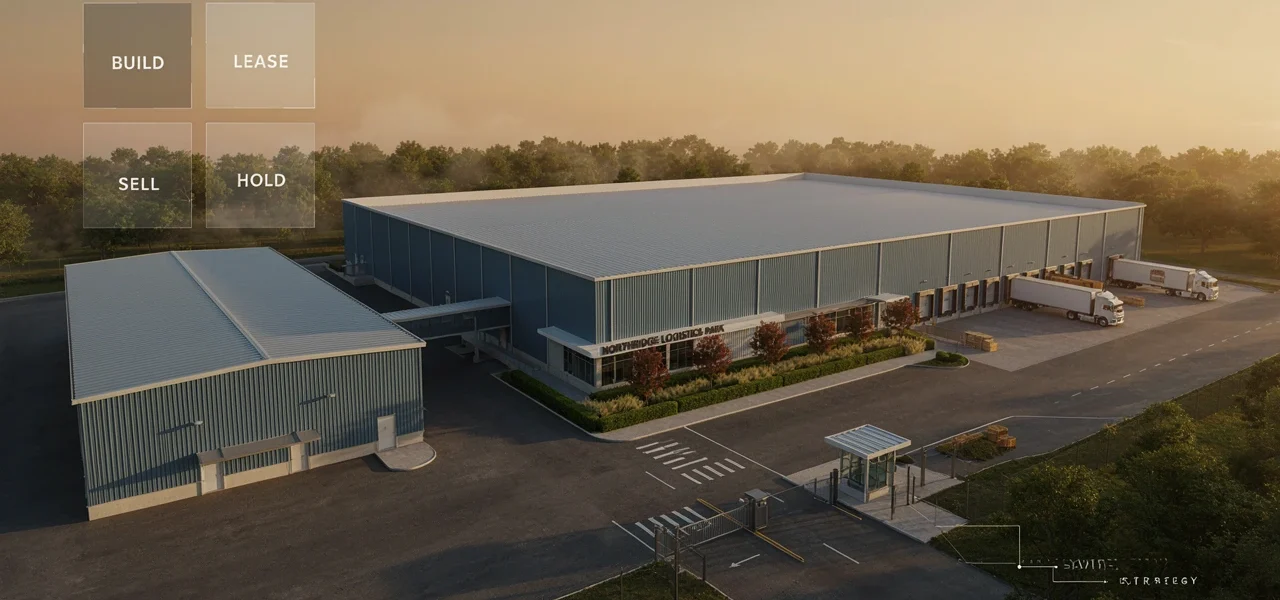
The future of industrial and logistics real estate in Limburg is increasingly connected to one of the Netherlands’ most important industrial ecosystems: Chemelot.
Situated between Geleen, Stein and Beek, near the A2 and A76 motorway junction at Kerensheide, Chemelot is more than a large chemical production site. It is an integrated industrial ecosystem bringing together chemical manufacturing, advanced materials, research, innovation and supporting businesses. With approximately 60 factories, 19 industrial companies and an extensive network of interconnected infrastructure, its influence extends well beyond the industrial park itself.
For the surrounding property market, this creates an important dynamic. Industrial growth does not simply generate demand for additional factory space. It also creates requirements for logistics facilities, specialised storage, distribution centres, technical services, supplier premises and strategically located industrial land.
As Chemelot moves towards circular chemistry, lower-carbon production and greater industrial resilience, the implications for commercial real estate are becoming increasingly significant.
For property owners, occupiers and investors, the question is no longer just how Chemelot will develop, but how the wider Limburg industrial landscape will respond.
1. Chemelot’s Expansion Is Reshaping Industrial Property Requirements
Chemelot’s industrial ecosystem depends on a continuous exchange of materials, energy, technical services and finished products. This interconnected structure creates demand for supporting businesses that need to operate close to the production site.
The presence of established companies such as SABIC, OCI, AnQore and Fibrant, alongside emerging industrial initiatives, reinforces the importance of the surrounding supply chain.
As production processes evolve, the requirements of occupiers are also changing.
Potential demand drivers include:
- Industrial and technical premises: Facilities for equipment maintenance, engineering, component manufacturing and industrial services
- Specialised logistics: Warehousing and handling facilities for industrial raw materials, intermediate products and finished goods
- Flexible industrial space: Premises accommodating smaller suppliers, specialist manufacturers and growing technology businesses
- Storage and distribution: Strategically located facilities supporting regional and cross-border supply chains
- Research and innovation: Additional requirements for pilot production, testing and specialist technical facilities around the Brightlands ecosystem
This creates opportunities beyond Chemelot’s existing industrial boundaries, particularly in locations where suitable land, infrastructure and industrial zoning are available.
For owners of existing industrial properties, it also raises an important question: does their current property meet the changing requirements of businesses operating within this expanding industrial ecosystem?
2. Circular Chemistry Is Creating New Real Estate Opportunities
One of the most significant developments influencing Chemelot’s future is its transition towards a circular industrial economy.
The cluster’s July 2026 strategic plan, Strategic autonomy through circular chemistry, brings together 12 fundamental projects focused on strengthening industrial competitiveness, sustainability and strategic autonomy. These include both established industrial operations and new technologies supporting circular production.
This transition has direct implications for industrial real estate.
As businesses increasingly incorporate recycled materials, renewable feedstocks and alternative production processes, the supporting infrastructure must evolve accordingly.
Three developments are particularly relevant:
Circular manufacturing and recyclingBusinesses involved in chemical recycling, material recovery and processing may require specialised industrial premises, additional storage capacity and suitable sites for handling secondary raw materials.
Energy and utility infrastructureElectrification, hydrogen networks, CO₂ management and industrial water systems are becoming important considerations for future industrial development. Properties with suitable utility connections and infrastructure capacity may become increasingly attractive.
Satellite industrial locationsNot every activity needs to operate within the Chemelot site itself. Supporting businesses may seek facilities elsewhere in South Limburg, creating opportunities for industrial estates and brownfield redevelopment.
For property investors, this means evaluating industrial assets beyond their existing rental income. Infrastructure compatibility, environmental permissions, redevelopment potential and proximity to industrial supply chains can become equally important value drivers.
3. The Strategic Importance of Limburg’s Industrial and Logistics Corridors
Chemelot’s influence is amplified by Limburg’s position at the intersection of major European transport and industrial networks.
The province identifies two important logistics hubs: Venlo-Venray in North Limburg and Sittard-Geleen-Stein in South Limburg. While North Limburg serves a broader distribution market, South Limburg’s logistics infrastructure is particularly connected to manufacturing, chemicals and automotive supply chains.
Several locations and corridors deserve particular attention:
| Corridor | Industrial and real estate relevance |
|---|---|
| Geleen-Sittard-Stein | Chemelot’s immediate industrial ecosystem, technical suppliers and supporting logistics |
| A2: Maastricht-Sittard-Eindhoven |
Connection to manufacturing centres, distribution networks and the wider Dutch economy |
| A76: Geleen-Heerlen-Aachen | Cross-border industrial connectivity with Germany |
| A67: Eindhoven-Venlo | Connection to North Limburg’s major logistics and distribution network |
| Born-Stein-Maas corridor | Inland shipping, industrial transport and multimodal logistics |
| Venlo-Venray | International distribution, warehousing and supply-chain operations |
The A2 and A76 junction at Kerensheide is particularly important for Chemelot. Meanwhile, the wider Rotterdam-Brabant-Limburg-Germany corridor connects the region to major European consumption and production markets.
Limburg’s combination of road, rail, inland waterways, pipelines and nearby airports strengthens its position as a multimodal logistics location. The provincial government also identifies the Chemelot pipeline network as Europe’s largest.
For industrial property owners, proximity to these transport networks can support occupier demand, particularly among businesses requiring reliable access to suppliers, manufacturing facilities and international customers. However, connectivity alone does not determine property value. Access restrictions, available labour, utility capacity, planning permissions and the suitability of existing buildings remain essential considerations.
4. Industrial Land Scarcity Is Increasing the Importance of Existing Assets
One of the most important considerations for Limburg’s property market is the availability of suitable industrial land.
A September 2026 report on the Westelijke Mijnstreek highlighted an anticipated requirement for 42-64 hectares of additional business land by 2030, compared with just over 20 hectares currently available for immediate development. The municipalities of Sittard-Geleen, Beek and Stein are therefore placing greater emphasis on the efficient use, revitalisation and sustainability of existing industrial estates.
This creates an important distinction between developing new industrial premises and unlocking the potential of existing properties.
For owners, opportunities may include:
- Redeveloping outdated industrial buildings into modern production or logistics facilities
- Repurposing vacant industrial premises for circular manufacturing and supporting businesses
- Intensifying existing sites where planning and infrastructure allow
- Exploring sale-and-leaseback arrangements to release capital while retaining operational control
- Evaluating whether underutilised land could support a higher-value industrial use
The strategic area vision around Chemelot also considers the revitalisation of surrounding business parks and the potential accommodation of new circular businesses on vacant or released plots.
For investors, this reinforces the importance of identifying existing assets with genuine redevelopment or repositioning potential rather than relying exclusively on new-build opportunities.
5. Chemelot’s European Connections Are Expanding Its Investment Significance
Chemelot’s influence is not limited to the Dutch industrial property market.
Its geographical position connects the Netherlands with Belgium and Germany, placing it within the wider Antwerp-Rotterdam-Rhine-Ruhr industrial area, commonly referred to as the ARRRA cluster.
This creates opportunities for businesses operating across European chemical, manufacturing and logistics supply chains.
The wider regional network includes:
- Antwerp: A major chemical and petrochemical centre supporting international industrial supply chains
- Rotterdam: A strategic gateway for global trade, raw materials and industrial distribution
- Duisburg and the Ruhr region: Important manufacturing, industrial processing and inland logistics markets
- Aachen and the German border region: Cross-border manufacturing, engineering and technology businesses
- Liège: An important Belgian logistics and industrial location connecting the region with wider European markets
In May 2026, Limburg presented Chemelot as a European strategic industrial cluster, highlighting its role in strategic autonomy, industrial innovation and sustainable competitiveness. The proposition specifically emphasised electrification, hydrogen, CO₂ management and circular chemistry.
For logistics and industrial real estate , these developments matter because occupier decisions increasingly consider entire supply chains rather than individual locations.
A business operating in Germany or Belgium may require additional Dutch warehousing, processing or supplier facilities to strengthen its regional operations.
Consequently, Limburg’s investment appeal should be assessed within the wider European industrial network, not simply through local property demand.
6. What This Means for Industrial Property Owners and Investors
Chemelot’s development presents different opportunities depending on the position of the property owner or investor.
For owners and occupiers, the changing industrial landscape creates an opportunity to reassess how their property supports future business requirements.
Questions worth considering include:
- Is the existing property suitable for modern industrial and logistics operations?
- Could redevelopment unlock additional value?
- Would a sale-and-leaseback transaction release capital for investment in core business activities?
- Could the site attract a new occupier from Chemelot’s expanding supplier ecosystem?
- Does the property have sufficient infrastructure and flexibility to accommodate future industrial requirements?
For investors, the focus should be on identifying properties with strong fundamentals, strategic connectivity and realistic value-enhancement potential.
This is particularly relevant across Geleen, Sittard, Stein, Beek and Born, where industrial activity, transport infrastructure and the availability of suitable premises intersect.
At the same time, investors should carefully assess energy availability, environmental restrictions, planning permissions, redevelopment costs and long-term occupier demand. Industrial growth does not automatically translate into demand for every property.
Identifying Opportunities Across Limburg
At RENEW Real Estate in the Netherlands, we see industrial clusters such as Chemelot as important drivers of long-term industrial and logistics property opportunities.
Our investment approach focuses on identifying strategically located industrial and logistics properties, assessing their commercial potential and exploring opportunities that create value for property owners and occupiers.
Across Limburg, this can involve several transaction and development strategies:
- Acquisitions: Industrial and logistics properties with established occupiers, strategic locations or value-enhancement potential
- Sale-and-leaseback: Enabling businesses to release capital from their real estate while retaining operational use of their premises
- Redevelopment: Unlocking the potential of outdated, vacant or underutilised industrial properties
- Build-to-suit development: Exploring opportunities to accommodate specific industrial and logistics requirements
- Strategic land opportunities: Evaluating sites suitable for future industrial development or repositioning
RENEW Real Estate invests its own equity alongside international institutional capital, focusing on opportunities across the Netherlands and selected European markets.
For owners considering a sale, redevelopment or alternative real estate strategy, the changing industrial landscape around Chemelot provides a relevant reason to reassess the property’s potential.
Limburg’s Industrial Transformation Is Also a Real Estate Opportunity
Chemelot’s evolution is about more than the future of chemical manufacturing. It reflects a broader transformation in how industrial businesses operate, source materials, manage energy, develop supply chains and use physical space.
From Geleen and Sittard to Stein, Beek, Born and the wider Venlo-Venray logistics region, these developments are creating new considerations for industrial and logistics real estate across Limburg.
The combination of circular manufacturing, strategic autonomy, infrastructure investment, cross-border connectivity and limited industrial land availability is making location and property suitability increasingly important.
For owners, the opportunity lies in understanding how their assets can support the next generation of industrial activity. For investors, it lies in identifying properties that are well positioned to benefit from these structural changes.
As Chemelot strengthens its position within Europe’s industrial landscape, Limburg’s existing industrial assets, strategically located land and redevelopment opportunities deserve closer attention.
At RENEW Real Estate in the Netherlands, we work with property owners, occupiers and intermediaries to evaluate industrial and logistics real estate opportunities , from acquisitions and sale-and-leaseback transactions to redevelopment and development strategies.
If you own or represent an industrial or logistics property in Limburg, let’s have a conversation about its potential.