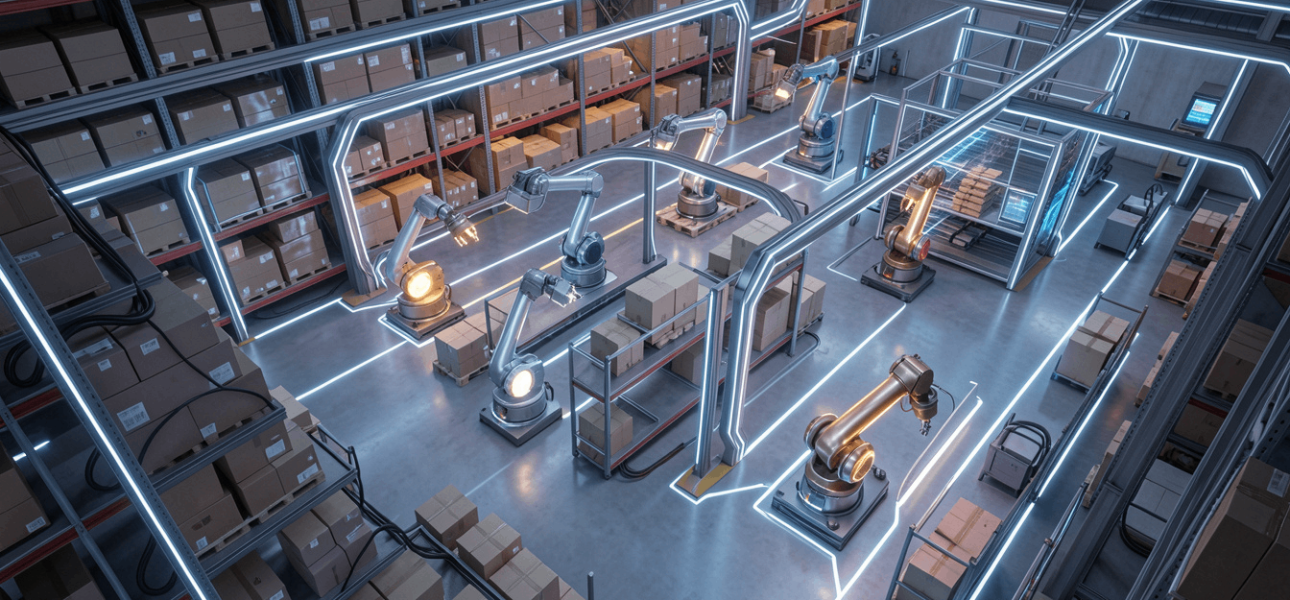
The logistics warehouse is undergoing a fundamental change. Across the Netherlands and wider Europe, businesses are investing in automation, robotics, digital warehouse management, energy efficiency and electrification to improve productivity and prepare their operations for the next phase of supply-chain demand.
For many occupiers, however, the challenge is not deciding whether modernisation is necessary. It is deciding how to fund it without compromising the financial flexibility of the business.
This is particularly relevant for companies that own their logistics or industrial properties. A warehouse may represent one of the largest assets on the balance sheet, while at the same time the business may be looking for substantial capital to invest in automation, technology, energy infrastructure or expansion.
A strategic sale and leaseback can provide a way to address both requirements. By selling an operational property to an investor and leasing it back, an owner-occupier can release capital tied up in the real estate while continuing to operate from the same facility. The capital can then be redirected towards the investments that improve the performance and competitiveness of the underlying business.
Automation Is Changing the Economics of the Warehouse
Warehouse automation has moved well beyond the large-scale distribution centres of major retailers and e-commerce companies. Logistics operators, manufacturers, wholesalers and distributors are increasingly evaluating automation as a way to improve throughput, accuracy and labour productivity.
Depending on the operation, modernisation may involve automated storage and retrieval systems, conveyors and sortation, robotic picking and palletising, autonomous mobile robots, warehouse management software or automated packaging. The right solution depends heavily on the type of operation, product mix, order volumes and existing building configuration.
These investments can be substantial. More importantly, they often require investment beyond the technology itself.
Automation may require changes to floor layouts, electrical systems, fire protection, power supply, loading areas or mezzanine structures. A business introducing a highly automated system may also need to upgrade its warehouse management technology and integrate the new equipment with existing ERP and transport systems.
The result is that warehouse automation is increasingly a real estate decision as well as a technology decision.
The Capital Allocation Question
For an owner-occupier, this creates a practical dilemma.
A company may own a logistics facility worth €10 million, €20 million or more, while simultaneously considering a multi-million-euro investment programme to modernise its operations. Traditional financing can be one route, but increasing borrowing is not always the preferred solution.
This is where management teams may need to look more closely at the capital already invested in their property.
If a business can unlock part of the value of its existing real estate through a sale & leaseback, that capital could potentially be used for investments such as:
- Warehouse automation and robotics
- New warehouse management and digital systems
- Energy efficiency and renewable energy infrastructure
- EV charging and fleet electrification
- Additional production or storage capacity
- Expansion into new geographic markets
- Acquisitions or strategic investments
- Working capital and balance-sheet strengthening
The important point is that the proceeds should have a clear strategic purpose. Selling a property simply to increase cash on the balance sheet does not necessarily create value. The case becomes much stronger when the released capital can be deployed into investments that improve revenue, productivity, margins or long-term competitiveness.
Why the Existing Location Can Be Worth Protecting
One of the strongest arguments for sale & leaseback in logistics is operational continuity.
A warehouse is rarely just a building. Its location is connected to transport routes, suppliers, customers, employees and the wider distribution network. A facility in Rotterdam-Rijnmond, for example, may be closely connected to the Port of Rotterdam and major European transport corridors. A facility in Venlo may play a different but equally important role in cross-border distribution into Germany and the wider European market.
The same applies to logistics locations across Brabant, Moerdijk, Almere, Zwolle, Arnhem-Nijmegen and other established industrial and logistics markets.
Relocating an operation simply because the company wants to release capital can introduce unnecessary disruption. It can mean moving inventory, changing transport routes, retraining or relocating employees and potentially losing some of the advantages associated with an established location.
A sale & leaseback offers another possibility: change the ownership of the real estate without changing the operational location of the business.
The company continues using the facility under a negotiated lease, while the property itself becomes an investment asset for the buyer.
Modernisation Is Also About Energy
Automation is only one part of warehouse modernisation.
Energy is becoming an increasingly important consideration for logistics and industrial occupiers across the Netherlands. Automated equipment, refrigeration, production processes, electric vehicles and charging infrastructure can all increase a facility’s electricity requirements.
At the same time, grid congestion is making access to additional power a significant consideration for businesses looking to expand or modernise.
This means that a modernisation programme may include investments in:
- Rooftop solar and energy generation
- Battery storage
- EV charging infrastructure
- LED and intelligent lighting systems
- Improved insulation and building efficiency
- Energy management systems
- Heat pumps and other building services
- Upgraded electrical infrastructure
For an owner-occupier, the property itself may therefore require substantial investment at the same time as the business is investing in automation and technology.
A sale & leaseback can potentially release capital to support these investments, depending on the structure of the transaction and the responsibilities agreed between the owner and occupier.
The Dutch Logistics Market Is Not Starting From Scratch
There is another reason this discussion matters in the Netherlands. The country already has a substantial base of logistics and industrial buildings in strategically important locations. Not every company needs a new warehouse to modernise its operation.
In many cases, an existing facility can be upgraded to support significantly more sophisticated logistics processes.
This could mean improving storage density, introducing automated picking, redesigning material flows or upgrading energy infrastructure. It could also involve relatively straightforward interventions such as improving loading areas, yard management, lighting, insulation or digital building systems.
The question is therefore increasingly shifting from “Do we need a new warehouse?” to “Can our existing warehouse be made significantly more productive?”
For an owner-occupier, that distinction matters.
If the building is in the right location and has the right underlying characteristics, modernising it may be considerably more attractive than relocating.
Sale & Leaseback as Part of a Wider Growth Strategy
A sale & leaseback should not be viewed in isolation.
For a business considering such a transaction, the property sale should ideally form part of a broader capital allocation strategy. Management should understand how much capital can realistically be released, what the ongoing occupancy cost will be and how the proceeds will be deployed.
For example, a logistics operator might use the proceeds to automate its existing facility while simultaneously investing in a second distribution location. A manufacturer could use the capital to expand production capacity. A transport and logistics business might allocate part of the proceeds towards fleet electrification and part towards an acquisition.
The property transaction becomes one component of a much larger business decision.
This is particularly important because a sale & leaseback introduces a long-term lease commitment. The structure therefore needs to reflect the company’s expected operating requirements, future growth plans and ability to support the rent over the lease term.
The objective is not simply to maximise the amount of capital released.
It is to create a capital structure that allows the business to invest and grow sustainably.
RENEW Real Estate’s Perspective
At RENEW Real Estate (RRE), sale & leaseback is approached from the perspective of both the real estate and the operating business.
RRE is an investor and acquirer of logistics and industrial real estate, working with owner-occupiers that may want to unlock capital from strategically important properties while continuing to operate from those locations.
The Netherlands provides a particularly relevant market for this approach because of its importance within European supply chains and the concentration of logistics activity around established transport corridors.
RRE has completed sale & leaseback transactions across several Dutch industrial and logistics markets.
In Greater Rotterdam, for example, RENEW Real Estate (RRE) acquired approximately 8,000 m² of warehouse space on a roughly 12,000 m² freehold site, including approximately 2,200 m² of Industrial Outdoor Storage. The transaction included a newly secured 10-year triple-net lease, allowing the occupier to continue its operations from the facility. RRE has also completed a sale & leaseback transaction in Almere involving approximately 7,600 m² of logistics space on a 10,014 m² freehold plot.
These transactions demonstrate an important characteristic of the model: the property can remain central to the occupier’s operations even after ownership has changed.
What Should Businesses Evaluate Before Modernising?
For an owner-occupier considering automation alongside a potential sale & leaseback, the two decisions should ideally be assessed together.
Several questions are particularly relevant:
How long will the business need the facility?
Automation investments often have long payback periods. A lease structure needs to provide sufficient operational certainty to justify those investments.
Can the building support the planned technology?
Floor loading, clear height, column spacing, power capacity, fire safety and building configuration can all affect the feasibility and cost of automation.
What additional infrastructure will be required?
Modernisation may require more than machinery. Energy systems, charging infrastructure, IT connectivity and building upgrades can form a significant part of the investment.
Where will the released capital create the greatest return?
The answer may be automation, expansion, acquisitions, fleet investment or another strategic priority.
Does the lease support the future business plan?
A business should consider expected growth, expansion requirements, maintenance responsibilities, rent increases and flexibility before entering into a long-term lease.
These considerations help ensure that the property transaction supports the operational strategy rather than becoming a separate financial exercise.
The Real Opportunity: Making Existing Assets Work Harder
The future of logistics real estate will not be defined only by the development of new warehouses.
A significant part of the opportunity lies in improving the performance of the buildings that already exist.
Strategically located facilities can often be upgraded, automated and adapted to meet changing operational requirements. For owner-occupiers, this creates an opportunity to combine the strengths of an established location with the productivity benefits of modern technology.
Sale & leaseback can support that transition by allowing businesses to reconsider how much capital they want to keep invested in the underlying property.
The warehouse remains.
The location remains.
The operation remains.
But the capital tied up in the property can potentially be redirected towards making the business more productive and competitive.
For logistics and industrial companies across the Netherlands, that may become increasingly important as automation, energy requirements and supply-chain complexity continue to reshape the sector.
The question is ultimately not whether a company should own its warehouse.
It is whether owning that warehouse remains the best use of the company’s capital at the point when its operations need to modernise and grow.
For some businesses, a sale & leaseback may provide the flexibility to answer that question differently, allowing real estate to support the next stage of business investment rather than competing with it for capital.