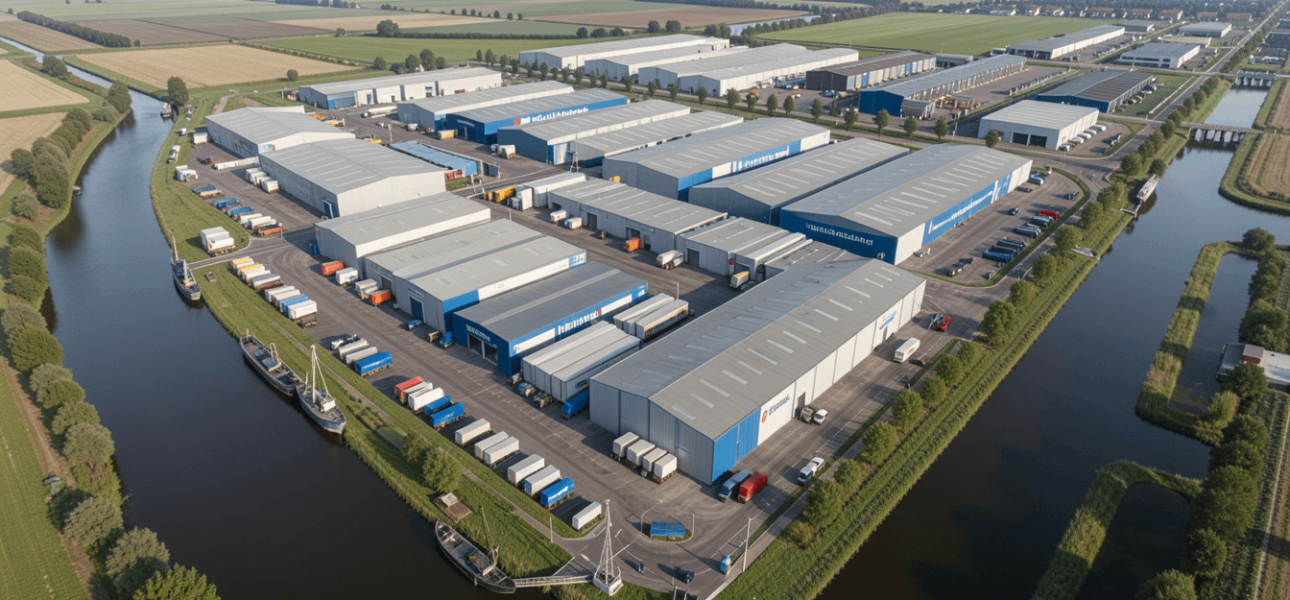
Across the Netherlands and Europe, logistics occupiers are increasingly rethinking how supply chains operate. Rising transportation costs, road congestion, labour shortages, ESG regulations, and pressure for faster distribution are reshaping logistics strategies across the region.
As a result, Dutch inland waterway logistics is becoming increasingly important for occupiers seeking more resilient, sustainable, and cost-efficient supply chains.
The Netherlands operates one of the most advanced inland shipping networks in Europe, with approximately 6,228 kilometres of inland waterways handling more than 300 million tonnes of cargo annually. This represents roughly 80% of Europe’s inland freight shipping activity, reinforcing the Netherlands’ position as Europe’s logistics gateway connecting the North Sea to the Rhine and Meuse corridors.
For logistics occupiers, this is becoming far more than a transportation advantage.
It is increasingly influencing:
- warehouse location strategy
- logistics real estate demand
- industrial developments
- supply chain resilience
- logistics asset acquisition decisions
- sale and leaseback opportunities
- long-term operational planning
As multimodal logistics networks become more important, occupiers are increasingly prioritizing logistics facilities connected to inland shipping infrastructure across the Netherlands.
Why Occupiers Are Turning Toward Inland Waterway Logistics
Across Europe, logistics operators are facing growing operational pressure.
Some of the biggest challenges include:
- road congestion
- rising fuel costs
- driver shortages
- supply chain disruptions
- increasing ESG requirements
- pressure for faster fulfilment
- higher transportation costs
To reduce dependency on road freight, occupiers are increasingly integrating inland shipping into distribution strategies.
The Dutch government continues investing heavily into inland logistics infrastructure as part of its broader sustainability and mobility strategy. This includes:
- modernization of inland terminals
- expansion of multimodal freight corridors
- infrastructure upgrades
- low-emission logistics initiatives
- inland port development
For occupiers, inland shipping provides several operational advantages:
- lower transportation costs
- reduced road dependency
- access to European hinterland markets
- improved supply chain flexibility
- lower carbon emissions
- stronger ESG alignment
As a result, occupiers are increasingly seeking logistics facilities positioned near inland shipping corridors and multimodal freight hubs.
The Netherlands as Europe’s Multimodal Logistics Gateway
The Netherlands continues to play a central role in European logistics due to its strategic location and highly connected infrastructure network.
Dutch inland waterways connect directly with:
- Germany
- Belgium
- France
- Switzerland
- Central European industrial regions
This allows goods arriving through the Port of Rotterdam to move efficiently across Europe through inland barges, rail, and multimodal transportation systems.
For occupiers, this creates major operational efficiencies.
Instead of relying entirely on trucking, companies can move containers and industrial freight deeper into Europe through sustainable inland logistics networks.
This is particularly relevant for:
- e-commerce occupiers
- industrial manufacturers
- retail distribution operators
- third-party logistics providers
- supply chain operators
The growing use of inland container shipping is also accelerating demand for strategically located logistics real estate across the Netherlands.
Inland Logistics Corridors Are Driving Real Estate Demand
As inland shipping volumes continue growing, occupiers are increasingly prioritizing logistics facilities located near multimodal freight corridors.
Key Dutch logistics regions benefiting from this trend include:
- Rotterdam
- Zuid-Holland
- Moerdijk
- Tilburg
- Breda
- Venlo-Venray
- Dordrecht
These regions offer:
- direct access to inland
- shipping routes
- strong highway connectivity
- proximity to ports
- access to European consumer markets
- multimodal freight capabilities
For occupiers, location selection is becoming increasingly strategic.
Warehouses positioned near inland logistics infrastructure can help:
- reduce transportation delays
- lower operational costs
- improve distribution efficiency
- support ESG targets
- strengthen supply chain resilience
As a result, demand for modern logistics real estate across these corridors continues to grow.
This is also increasing interest in:
- industrial developments
- built-to-suit logistics facilities
- future-ready warehousing
- multimodal distribution centres
Sustainability Is Reshaping Occupier Decisions
Sustainability is becoming a major factor in logistics real estate decisions across Europe.
Many occupiers are now under pressure to reduce emissions across transportation and warehousing operations.
Inland waterway logistics is increasingly viewed as a practical solution because it significantly reduces congestion and lowers emissions compared to traditional road freight.
This is influencing occupier demand for:
- ESG-ready logistics facilities
- energy-efficient warehouses
- multimodal industrial assets
- electrification-ready sites
- sustainable distribution hubs
At the same time, many occupiers are investing heavily into:
- warehouse automation
- robotics
- AI-driven logistics systems
- digital supply chain infrastructure
These investments require substantial capital.
As a result, sale and leaseback structures are becoming increasingly relevant within the logistics sector.
How Sale and Leaseback Supports Occupier Growth
Many occupiers across the Netherlands and Europe continue to own highly valuable logistics real estate acquired years ago at significantly lower valuations.
At the same time, businesses require liquidity to invest into:
- automation
- ESG upgrades
- fleet electrification
- inland distribution expansion
- supply chain modernization
Sale and leaseback structures allow occupiers to unlock capital tied up in owned logistics facilities while continuing operations from the same property.
Operationally, nothing changes:
- the occupier remains in the facility
- business continuity is maintained
- supply chains remain uninterrupted
Financially, however, occupiers gain access to capital that can support future operational growth.
This is becoming increasingly important as occupiers adapt to evolving European logistics requirements.
How RENEW Real Estate Supports Occupier-Focused Logistics Strategies
As inland logistics infrastructure continues reshaping European supply chains, RENEW Real Estate continues supporting occupiers through long-term logistics and industrial real estate investment solutions across the Netherlands and Europe.
RRE operates as a strategic partner and direct investor focused on:
- logistics asset acquisition
- sale and leaseback transactions
- industrial developments
- built-to-suit developments
- future-oriented logistics real estate
RRE’s investment approach aligns with several major occupier priorities shaping the European logistics market:
- resilient supply chains
- sustainable logistics infrastructure
- warehouse modernization
- multimodal freight access
- operational flexibility
- long-term real estate stability
By supporting logistics facilities located within key inland shipping corridors, RRE helps occupiers position operations closer to Europe’s evolving freight infrastructure network.
At the same time, sale and leaseback structures enable occupiers to unlock capital from owned assets while maintaining operational continuity and long-term control over strategic facilities.
The Future of Inland Waterway Logistics and Occupier Demand
Dutch inland waterway logistics is rapidly becoming a major driver of occupier demand across Europe.
As supply chains become more sustainability-focused and transportation networks grow more complex, occupiers are increasingly prioritizing:
- multimodal logistics access
- inland distribution connectivity
- future-ready logistics facilities
- resilient industrial infrastructure
- ESG-aligned operations
This is accelerating demand for strategically located logistics real estate throughout the Netherlands.
For occupiers, inland shipping is no longer simply an alternative transportation method.
It is becoming a core part of long-term logistics strategy.
As Europe continues shifting toward more sustainable and resilient supply chains, logistics facilities connected to inland waterway infrastructure will likely become even more important for future distribution networks.
In this evolving environment, strategic investors such as RENEW Real Estate continue supporting occupiers through logistics asset acquisition, sale and leaseback structures, industrial developments, and built-to-suit logistics investments aligned with the future of European supply chains.