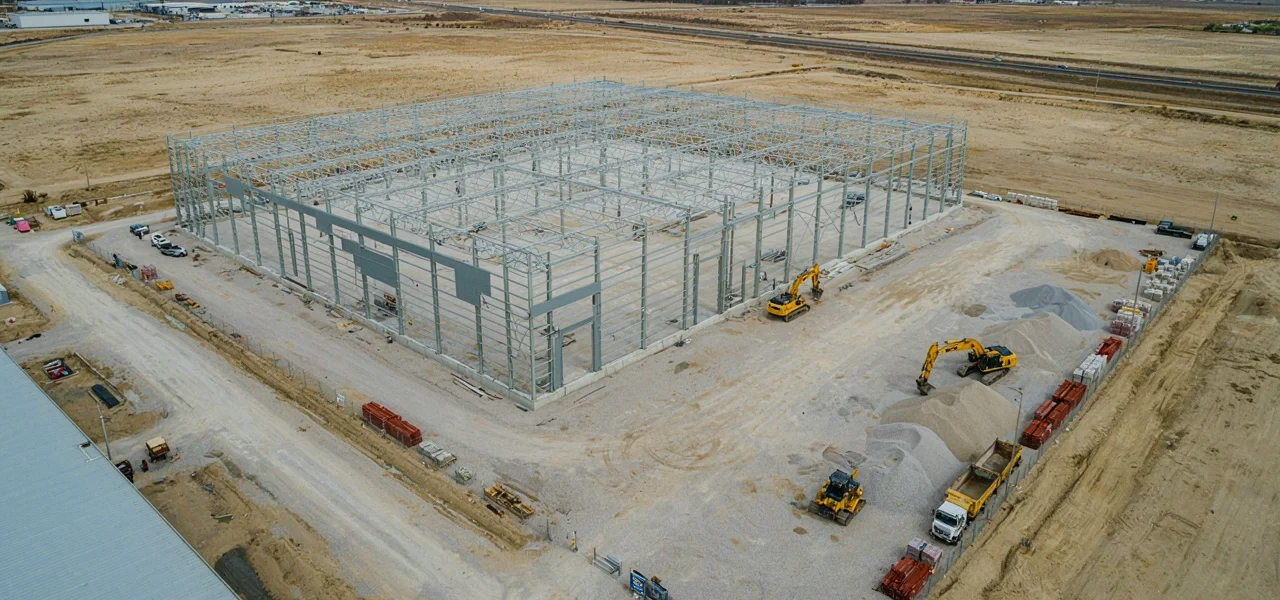
For years, logistics real estate development across the Netherlands and Europe followed a relatively straightforward model: secure land, build a modern warehouse and attract occupiers. Today, that approach is becoming more challenging. Higher construction costs, tighter financing conditions, limited land availability and infrastructure constraints are changing how developers evaluate new projects.
Pre-let demand is playing an increasingly important role in this shift. By securing a tenant before construction begins, developers can establish greater visibility over future rental income, reduce leasing uncertainty and strengthen the commercial case for development.
In the Netherlands, where land scarcity, grid congestion, permitting requirements and nitrogen-related restrictions can complicate new construction, securing occupier demand early can be particularly valuable. Across Europe, businesses are also reassessing their property requirements in response to changing supply chains, operational costs and evolving distribution strategies.
The result is a more selective development environment in which understanding demand before committing capital is becoming just as important as identifying the right location.
Why pre-let commitments matter in the Netherlands
The Netherlands occupies a strategic position within European supply chains. Rotterdam’s port, Schiphol Airport, established transport infrastructure and connections to Germany and Belgium make the country an important base for logistics, distribution and industrial operations.
However, access to suitable space is becoming more complex. Land availability is limited in established logistics corridors, electricity connections can be difficult to secure, and planning procedures can affect both project feasibility and delivery timelines.
These constraints influence development economics in two ways.
First, developers face greater uncertainty around costs and delivery schedules. The longer a project takes to complete and generate income, the greater the importance of managing capital exposure and leasing risk.
Second, available space does not automatically meet occupier requirements. Businesses may need specific building dimensions, clear heights, floor-loading capacity, loading infrastructure, automation systems or substantial power capacity. A vacant warehouse that cannot accommodate these requirements may be unsuitable despite being available.
Pre-letting helps bring these requirements into the development process earlier. Rather than building speculatively and adapting the property later, developers can assess demand, specifications and commercial terms before committing significant capital.
For occupiers, this can mean greater influence over the facility they eventually use. For developers and investors, it can provide a clearer basis for evaluating a project’s viability.
Built-to-suit: designing around the occupier
Built-to-suit (BTS) development takes this approach further. Instead of leasing a standard building before completion, the property is designed around a specific occupier’s operational requirements.
For logistics operators, manufacturers and distribution businesses, this may involve customised storage configurations, automated handling systems, production areas, loading capacity, energy infrastructure and provisions for future expansion.
The benefits extend beyond the building itself. A facility designed around operational workflows can improve handling efficiency, reduce unnecessary movement, support automation and help businesses consolidate activities across multiple locations.
BTS can also provide developers with greater visibility over the intended use of the property and its leasing structure before construction begins. However, the approach requires careful planning. Highly specialised buildings can be more difficult to re-let if the original occupier leaves, while changes to specifications can affect development costs and delivery schedules.
The strongest projects balance customisation with long-term adaptability. A building should meet the immediate needs of its first occupier without unnecessarily limiting its appeal to future tenants.
As businesses increasingly focus on operational efficiency, automation readiness and energy performance, this balance is becoming an important consideration in Dutch and wider European industrial development.
Benelux: a connected market with different opportunities
The Netherlands, Belgium and Luxembourg form an interconnected logistics region, but each market offers distinct advantages.
The Netherlands benefits from its international transport connections and established logistics corridors around Rotterdam, Tilburg, Waalwijk, Venlo and Eindhoven. Belgium provides access to the Port of Antwerp-Bruges, manufacturing clusters and important cross-border routes. Luxembourg offers a strategic position for selected distribution and industrial activities serving neighbouring European markets.
For occupiers evaluating the Benelux region, the decision increasingly goes beyond headline rent. Labour availability, transport access, power capacity, planning timelines and the suitability of the building all influence the total cost of operating a facility.
Pre-let and BTS strategies can help businesses secure space that meets their requirements in locations where suitable alternatives may be limited. Early engagement also allows developers to assess whether a project’s location, infrastructure and specifications align with genuine occupier demand.
For investors, however, the presence of a committed tenant is only one part of the equation. Location quality, lease terms, tenant covenant strength and the property’s future adaptability remain essential to long-term value.
Europe’s evolving logistics and industrial requirements
Across Europe, logistics and industrial real estate is being influenced by changes in supply-chain strategy, nearshoring, inventory management and manufacturing investment.
Some businesses are consolidating operations into fewer, more efficient facilities. Others are positioning distribution networks closer to customers, suppliers or production centres. These decisions are increasing the importance of properties that can accommodate specific operational requirements rather than simply provide additional floor space.
Energy efficiency, reliable power infrastructure, automation and the ability to adapt to changing business needs are becoming more prominent in development decisions.
At the same time, higher construction costs and more selective financing have increased the importance of evaluating speculative projects carefully. Without a committed occupier, developers must account for potential leasing delays, incentives, changing market conditions and the cost of holding completed space before it generates income.
A pre-let agreement can improve income visibility and support financing discussions, but it does not eliminate development risk. Construction costs, planning approvals, delivery schedules, lease structures and the financial strength of the tenant must still be assessed.
Nor is the trend identical across every European market. Speculative development can remain commercially attractive where demand is strong and modern supply is limited. In other locations, securing an occupier before construction may offer a more appropriate risk-return balance.
The decision ultimately depends on local market conditions, the specific asset and the requirements of its intended users.
What this means for owners, occupiers and investors
The changing economics of logistics development create different considerations for each stakeholder.
For occupiers, early engagement can provide greater influence over building specifications, energy requirements and delivery schedules. Businesses considering expansion, relocation or consolidation should assess property requirements alongside their wider operational and capital-allocation plans.
For developers and landowners, pre-let demand can help establish whether a project has a credible commercial foundation before substantial capital is committed. However, feasibility still depends on realistic construction costs, infrastructure access, planning approvals and lease terms.
For investors, a committed lease can improve income visibility, but long-term value depends on more than initial occupancy. Building quality, location, tenant covenant strength and adaptability remain important considerations.
For corporate property owners, the discussion may extend beyond leasing or development. Businesses holding valuable industrial or logistics real estate may wish to assess whether their existing property continues to serve their operational and financial objectives.
A sale-and-leaseback (SLB) transaction can provide one option for releasing capital tied up in property while allowing a business to continue operating from the facility under a lease. Depending on the circumstances, this can form part of a broader capital-allocation strategy, particularly when a business is considering expansion, acquisitions or changes to its operating footprint.
These decisions are interconnected. Property strategy, business requirements and capital allocation are often most effective when considered together.
A more selective market rewards early decisions
Pre-let demand is changing the economics of Dutch logistics development by shifting the emphasis from building first and leasing later towards understanding demand before committing capital.
In a market shaped by land scarcity, infrastructure constraints, development costs and evolving occupier requirements, early engagement can help align property design with commercial reality. Built-to-suit projects offer a more tailored approach, while the wider Benelux and European markets provide businesses with different options for distribution, manufacturing and network optimisation.
Neither pre-letting nor customisation removes development risk. Both, however, can improve the alignment between a property’s intended use, its commercial structure and its long-term investment potential.
For RENEW Real Estate, this is where understanding both the property and the business behind it becomes essential. We invest in industrial and logistics real estate alongside international institutional capital, focusing on opportunities where asset potential, occupier requirements and investment fundamentals align.
Whether the opportunity involves an acquisition, a new development, a built-to-suit facility or a sale-and-leaseback transaction, the starting point is the same: understand the underlying business need, assess the property’s long-term potential and establish a commercially viable route forward.
In the next phase of the market, the most compelling logistics developments may not necessarily be those built first. They may be those where demand, location, infrastructure and capital come together before construction begins.