Project Case Study | Industrial Development | Greater Utrecht, the Netherlands
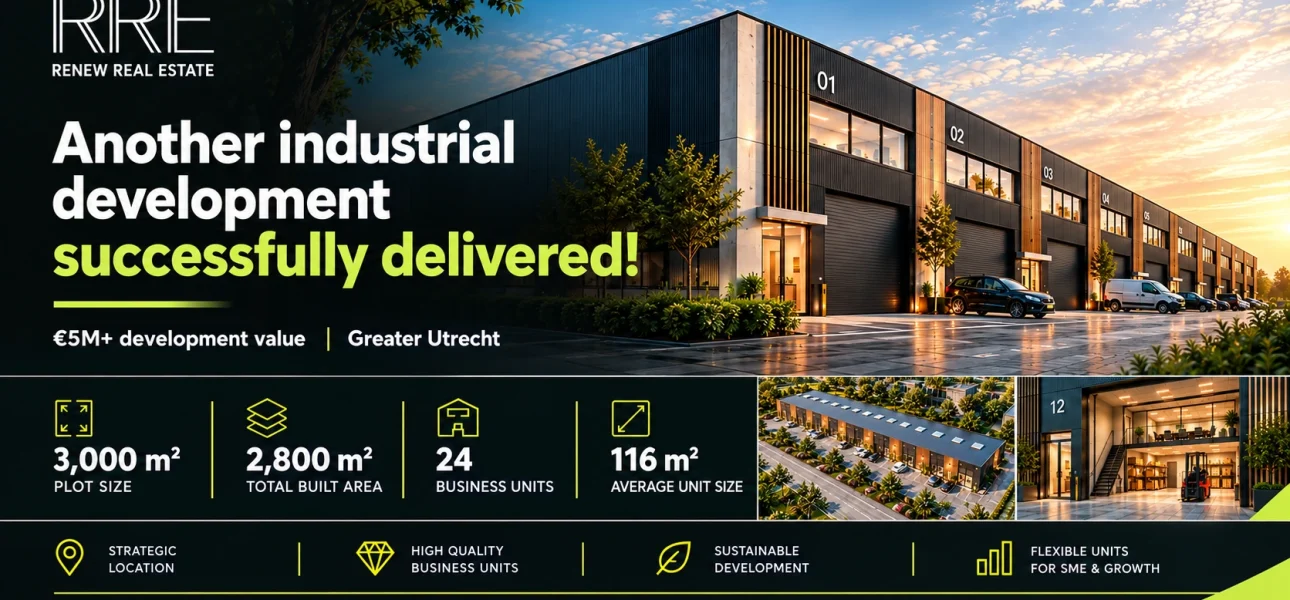
3,000 sqm industrial development | €5M+ development value | Land transfer completed | End-user delivery scheduled for November 2026
Turning an industrial site into a development opportunity requires more than identifying a suitable piece of land. It calls for a clear understanding of location, commercial potential, occupier requirements and the factors that influence a property’s long-term relevance.
RENEW Real Estate has successfully participated in the development of a new 3,000 sqm industrial property in Greater Utrecht, with a total development value exceeding €5 million. With the land transfer completed and end-user delivery scheduled for November 2026, the project represents another milestone in RRE’s involvement in the Dutch industrial real estate market.
Although the details of the transaction remain confidential, the project offers an opportunity to examine the broader considerations behind industrial development in one of the Netherlands’ strategically connected regions.
1. Why Greater Utrecht for Industrial Real Estate?
Location remains a fundamental consideration in industrial and logistics real estate. For businesses, the right location can influence distribution efficiency, access to customers, workforce accessibility and the practicalities of day-to-day operations.
Logistics hubs like Greater Utrecht benefit from its central position within the Netherlands. The region sits at the intersection of important national transport routes, connecting businesses with major Dutch cities and wider European markets. Its road and rail infrastructure, together with its proximity to Amsterdam Airport Schiphol and the Port of Rotterdam, strengthens its role as a business and distribution location.
For industrial occupiers and logistics operators, this connectivity can support a range of activities, from regional distribution and warehousing to manufacturing, storage and business operations requiring reliable access to suppliers and customers.
The A2 and A12 motorway corridors are particularly relevant to the wider Utrecht area. These routes connect the region with other important economic centres in the Netherlands, although actual journey times and accessibility depend on the specific property location and traffic conditions.
This combination of centrality and transport infrastructure makes Greater Utrecht an important region to consider when evaluating industrial property opportunities.
2. The Development Opportunity of 3,000 sqm with a €5M+ Value
The project involved the development of a new 3,000 sqm industrial property in Greater Utrecht, with a total development value exceeding €5 million.
While the specific site, transaction structure and parties involved remain confidential, the confirmed project milestones establish the scale and progress of the development.
The land transfer has been completed, and delivery of the property to the end user is scheduled for November 2026. These milestones represent important stages in the progression of industrial development. Moving from a site transaction towards a completed property involves multiple considerations, including the intended use of the asset, the development programme and the requirements that must be met before handover.
For industrial real estate, the commercial relevance of a development extends beyond its size or headline value. Its location, suitability for its intended purpose and relationship with occupier requirements all contribute to its overall proposition.
The Greater Utrecht project adds to RENEW Real Estate’s experience across industrial property opportunities in the Netherlands.
3. Why Connectivity Matters in Industrial and Logistics Development
Connectivity is more than a location advantage. It is a practical consideration that can influence how an industrial property serves its occupier.
For businesses dependent on the movement of goods, access to major roads and distribution routes can affect the efficiency of inbound supplies, outbound deliveries and connections with regional and national markets.
Greater Utrecht’s central position provides access to the Netherlands’ wider transport network, while the region’s proximity to Schiphol Airport and the Port of Rotterdam supports connections with international passenger and freight infrastructure. The relevance of these connections varies by business model, transport mode and the property’s precise location.
For industrial occupiers assessing a property, several location factors are worth considering:
- Road connectivity: Access to motorways and regional roads can support distribution, deliveries and connections with customers and suppliers
- Market accessibility: A central location can help businesses serve multiple markets from a single operational base
- Workforce access: Connectivity by road and public transport can influence the accessibility of a facility for employees
- Operational suitability: Vehicle access, site layout, loading arrangements and the property’s suitability for its intended use are important alongside its wider geographic position
- Long-term flexibility: A well-considered location can support a business as its operational requirements evolve, subject to the property’s physical and planning constraints
These considerations help explain why location analysis is an important part of evaluating industrial development opportunities.
However, connectivity alone does not determine a property’s success. The specific site, planning framework, building specifications, development costs and occupier requirements must also be considered.
4. From Land Transfer to End-User Delivery
A development project progresses through a series of milestones, each contributing to the wider objective of bringing a property into use.
For the Greater Utrecht project, the completion of the land transfer marks a confirmed milestone. The next major milestone is the scheduled delivery of the completed industrial property to its end user in November 2026. The period between these milestones is an important part of the development journey. It is during this phase that the project progresses towards its intended outcome.
For industrial and logistics real estate , the relationship between the asset and its intended occupier is particularly relevant. A property must be suitable for its intended operational purpose, while the development must progress in line with the applicable project requirements.
For investors and property owners, understanding these milestones can also help distinguish between an early-stage development opportunity, a project progressing through development and a completed asset.
The Greater Utrecht project is currently progressing towards its scheduled delivery milestone. Its confidential transaction details are not disclosed, but its development size, value and confirmed progress provide a clear picture of the project’s scale.
5. The Broader Context
The Dutch industrial real estate market encompasses a diverse range of opportunities, from existing industrial buildings and logistics facilities to development sites and properties with redevelopment potential.
For occupiers, property decisions may be driven by changing operational needs, expansion plans, location requirements or the suitability of existing premises.
For property owners and investors, opportunities may involve acquiring an existing asset, developing a new property, repositioning an underutilised building or considering alternative ownership and capital strategies. These different requirements create a varied landscape for industrial real estate investment and development.
Location remains a key consideration, but it must be assessed alongside other factors, including planning constraints, building specifications, land availability, infrastructure capacity and the commercial requirements of the intended user.
In established economic regions such as Utrecht, these considerations are particularly relevant when evaluating individual sites. The wider region may offer strong connectivity, but the suitability and potential of any specific property depend on its own characteristics and circumstances.
For market participants, this reinforces the importance of evaluating each industrial property opportunity on its individual merits rather than relying on location or asset size alone.
6. RENEW Real Estate’s Experience Across Industrial Property Opportunities
RENEW Real Estate brings a track record of more than 110 closed transactions and €1.1 billion in transactional volume. Its activities span Dutch industrial and logistics real estate, including acquisitions, sale & leaseback transactions, commercial and industrial development, redevelopment and asset repositioning. This experience provides a broader perspective on the different ways industrial properties can create commercial opportunities.
For example, an owner-occupier may be considering a new facility to support its operations, while another business may be exploring a sale & leaseback transaction as part of a wider property or capital strategy. A property owner may also be evaluating the potential of an existing asset, while a broker or corporate advisor may be working on an acquisition or development opportunity.
Each situation has its own commercial considerations. Understanding the asset, the parties’ objectives and the potential transaction or development pathway is central to assessing whether an opportunity merits further exploration.
RRE’s participation in the Greater Utrecht development adds to its experience across these areas of the Dutch industrial real estate market.
Identifying the Next Industrial Development Opportunity
The Greater Utrecht project forms part of RENEW Real Estate’s continued involvement in industrial real estate opportunities across the Netherlands.
RRE is actively looking for development sites, redevelopment opportunities and industrial projects with commercial potential.
These opportunities may include:
- Industrial and logistics development land
- Existing industrial properties with redevelopment or repositioning potential
- Acquisition opportunities involving industrial and logistics assets
- Sale & leaseback opportunities involving owner-occupied industrial property
- Opportunities introduced by brokers, property owners, occupiers and M&A advisors
For property owners and occupiers, an initial conversation does not require a fully developed transaction proposal. It can be an opportunity to discuss the property, understand the available options and assess whether there may be a basis for further engagement.
For brokers and advisors, sharing an opportunity can open a conversation around its commercial characteristics and potential fit.
Building on Industrial Real Estate Experience
The Greater Utrecht development represents a €5M+ industrial real estate project involving 3,000 sqm of new industrial space. With the land transfer completed and end-user delivery scheduled for November 2026, the project marks another milestone in RENEW Real Estate’s involvement in the Dutch market.
The wider context highlights the importance of location, transport connectivity, occupier requirements and development progress when evaluating industrial property opportunities.
For RRE, the focus remains on identifying and progressing opportunities across acquisitions, development, redevelopment, sale & leaseback and asset repositioning.