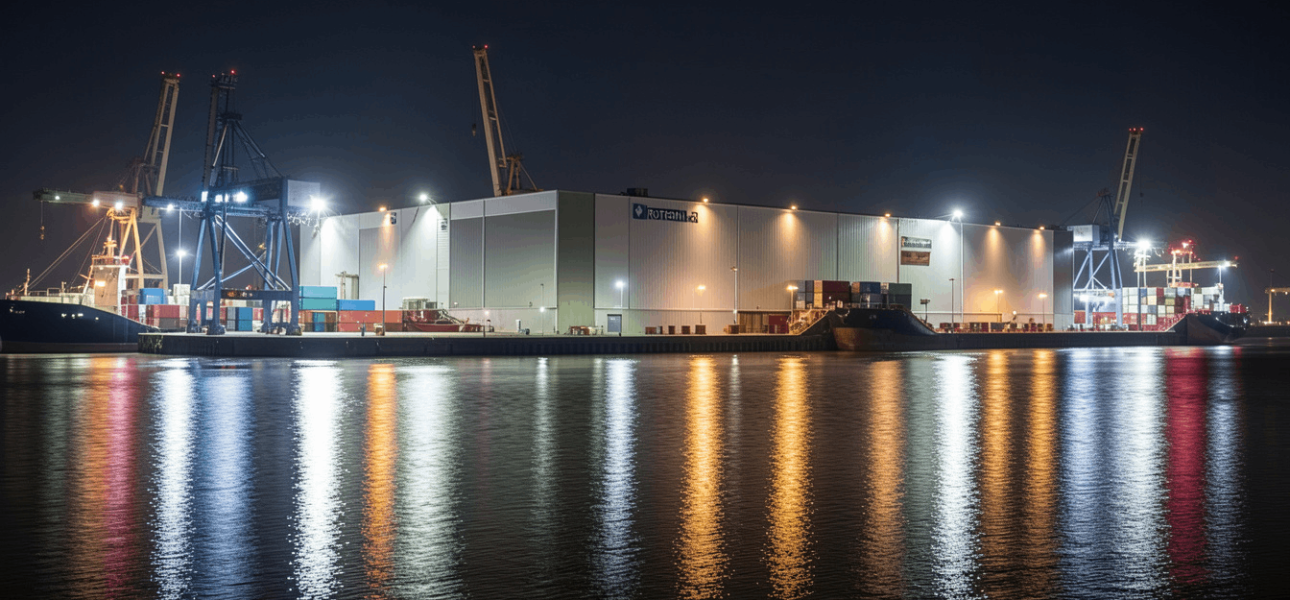
In an increasingly complex global economy, logistics real estate has evolved from being a supporting business function to becoming a strategic asset that shapes supply chain resilience, business continuity, and long-term corporate growth. As companies across Europe rethink their manufacturing footprints, distribution networks, and capital allocation strategies, the importance of location has never been greater.
At the heart of this transformation lies Rotterdam-Rijnmond, a region that continues to set the benchmark for logistics and industrial real estate in the Netherlands and across Europe. Anchored by the Port of Rotterdam, Europe’s largest seaport, the region combines world-class infrastructure, multimodal connectivity, a mature occupier market, and a strong investment ecosystem that continues to attract institutional investors, owner-occupiers, developers, and logistics operators.
While market cycles inevitably influence investment activity, the long-term fundamentals of Rotterdam-Rijnmond remain exceptionally strong. For businesses looking to expand operations, optimise capital, or secure future-ready logistics facilities, the region continues to present compelling opportunities.
A Logistics Hub Built for Long-Term Growth
Rotterdam-Rijnmond’s strategic advantage extends far beyond its geographic location. It serves as the primary gateway connecting international trade with key European markets, enabling seamless movement of goods through an integrated network of road, rail, inland waterways, and short-sea shipping.
For logistics operators, manufacturers, e-commerce businesses, and distributors, this connectivity translates into shorter lead times, lower transportation costs, and greater supply chain resilience. It is no surprise that the region has become home to some of Europe’s most advanced logistics parks, distribution centres, and industrial facilities.
At the same time, ongoing investments in infrastructure, digitalisation, and sustainable transport continue to reinforce Rotterdam-Rijnmond’s position as one of Europe’s most competitive logistics markets.
Why Investors Continue to Focus on Rotterdam-Rijnmond
Despite economic uncertainty in recent years, demand for high-quality logistics real estate in the Netherlands has remained resilient. One of the key reasons is the continued imbalance between supply and demand, particularly for well-located industrial and logistics assets .
Land availability within Rotterdam-Rijnmond is increasingly limited due to urban expansion, environmental regulations, and planning constraints. As a result, existing logistics properties in strategic locations continue to attract strong investor interest.
Institutional investors are increasingly seeking assets that offer long-term income stability, high-quality occupiers, and the flexibility to meet evolving sustainability requirements. Modern warehouses with strong ESG credentials, efficient layouts, and future-ready infrastructure have become particularly attractive investment opportunities.
For investors, success is no longer simply about acquiring industrial property, it is about identifying assets capable of delivering sustainable value over the long term.
Capital Optimisation Is Driving Sale & Leaseback Activity
For many owner-occupiers, industrial real estate represents one of the largest assets on the balance sheet. While these facilities are essential to daily operations, they also tie up significant capital that could otherwise be invested in business expansion, automation, acquisitions, or sustainability initiatives.
This has led to growing interest in sale and leaseback transactions across the Dutch logistics market.
Rather than relocating or disrupting operations, businesses can unlock capital from their real estate while continuing to operate from the same facility under a long-term lease agreement. The result is greater financial flexibility without compromising operational continuity.
As businesses adapt to changing market conditions, Sale & Leaseback is increasingly viewed as a strategic financial decision rather than simply a real estate transaction. For CFOs, business owners, and corporate decision-makers, it offers an opportunity to strengthen balance sheets while supporting future growth ambitions.
Industrial Development Is Responding to Changing Business Needs
The logistics sector is evolving rapidly. Automation, robotics, electrification, and stricter sustainability requirements are changing the way industrial facilities are designed and operated.
Many older warehouses no longer meet the operational requirements of modern occupiers. Ceiling heights, loading capacities, energy performance, and power availability have become critical considerations for businesses planning long-term operations.
As a result, industrial development is playing an increasingly important role in the Dutch logistics market.
New developments are being designed with flexibility, energy efficiency, and operational performance at their core. Features such as BREEAM certification, rooftop solar installations, electric vehicle infrastructure, and smart warehouse technologies are no longer viewed as optional enhancements, they are becoming standard expectations.
For occupiers, investing in future-ready facilities supports productivity and regulatory compliance. For investors, these assets are better positioned to retain long-term value and attract quality tenants.
Built-to-Suit Developments Are Becoming a Competitive Advantage
While speculative developments continue to play an important role, many businesses require facilities tailored to their operational requirements.
Built-to-suit developments are becoming increasingly popular among manufacturers, logistics operators, and distribution companies seeking bespoke solutions that align with their business strategies.
Whether supporting automated fulfilment centres, temperature-controlled storage, production facilities, or specialised distribution hubs, built-to-suit developments provide occupiers with greater operational efficiency while allowing future expansion to be incorporated into the design from the outset.
As supply chains become more sophisticated, customised industrial facilities are expected to become an increasingly important component of the Dutch logistics landscape.
The Value of a Strategic Real Estate Partner
Successfully navigating today’s logistics real estate market requires more than identifying available properties. Businesses and investors increasingly need a partner who understands local market dynamics, investment trends, occupier requirements, and long-term asset performance.
This is where specialist logistics real estate expertise becomes invaluable.
RENEW Real Estate (RRE) is a specialist in logistics and industrial real estate investments across the Netherlands. We originate and execute off-market acquisitions, structure sale & leaseback transactions and deliver build-to-suit and development opportunities for owner-occupiers, investors and developers. Through deep market expertise, an extensive industry network and an entrepreneurial approach, RRE unlocks value, creates capital solutions and delivers real estate strategies that support long-term growth and operational continuity.
Looking Ahead
As European supply chains continue to evolve, logistics real estate will remain one of the most important asset classes supporting economic growth and business resilience. The demand for strategically located, sustainable, and operationally efficient industrial facilities is expected to continue shaping investment decisions across the Netherlands.
Rotterdam-Rijnmond is uniquely positioned to remain at the centre of this transformation. Its unrivalled connectivity, mature logistics ecosystem, limited land availability, and strong occupier demand continue to reinforce its position as Europe’s most strategic logistics real estate investment region.
For investors seeking resilient assets, occupiers planning future expansion, and businesses exploring new ways to optimize capital, the region offers opportunities that extend far beyond property ownership. It represents a market where infrastructure, innovation, and long-term thinking come together to create lasting value, qualities that continue to define both the region and the evolving future of logistics real estate in the Netherlands.