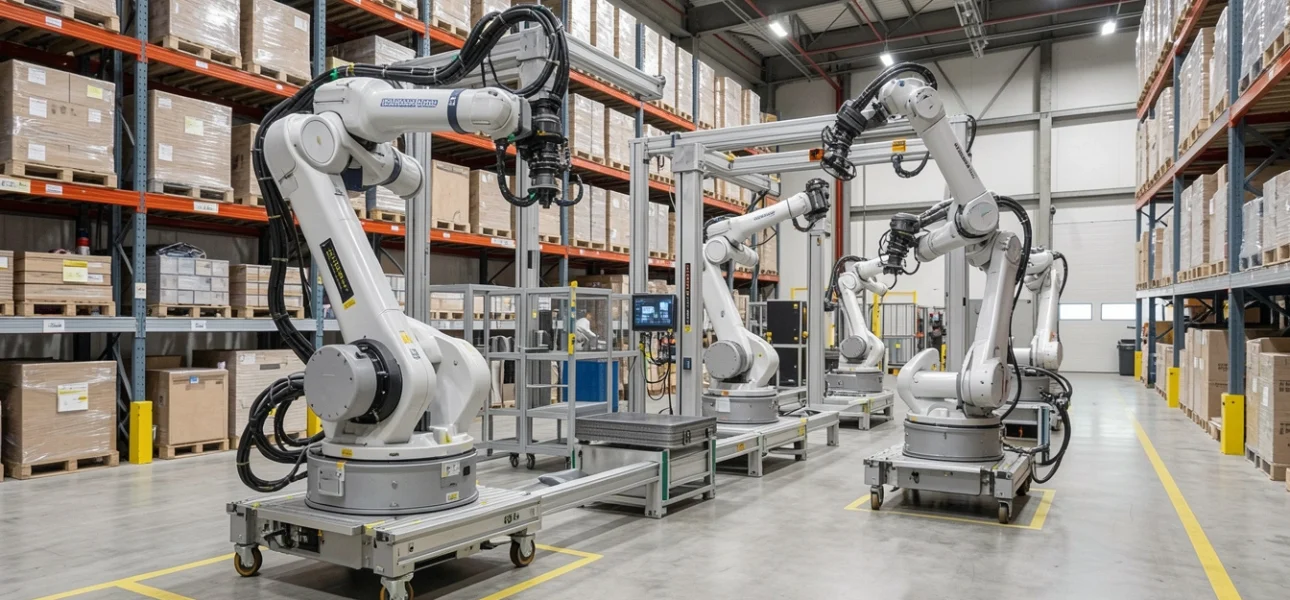
Across the Netherlands and Europe, logistics occupiers are under increasing pressure to modernise warehouse operations. Rising labour shortages, growing e-commerce volumes, supply chain disruptions, and increasing customer expectations around speed and efficiency are reshaping how logistics facilities are designed and operated. As a result, warehouse automation has moved from being a long-term ambition to an immediate operational priority.
From robotics and autonomous forklifts to AI-driven warehouse management systems and automated storage and retrieval systems (AS/RS), logistics operators are investing heavily in technologies that improve throughput, reduce operational risk, and future-proof supply chains. However, these investments require substantial capital.
This is where sale & leaseback has become increasingly relevant.
In the Netherlands and across Europe, sale & leaseback structures are now being used not only to optimize balance sheets, but also to fund strategic warehouse automation programmes while maintaining operational continuity. For logistics occupiers, it offers a way to unlock capital tied up in owned real estate and redirect it into automation technologies that directly support growth and efficiency.
The Shift Toward Automated Logistics Infrastructure
Europe’s logistics market is evolving rapidly. According to the European Real Estate Logistics Census, logistics assets now account for a significantly larger share of real estate capital deployment compared to previous years, reflecting strong investor conviction in the sector.
At the same time, warehouse occupiers are facing mounting operational challenges:
- Persistent labour shortages
- Rising labour costs
- Pressure for faster fulfilment
- Increasing demand for resilient supply chains
- ESG and energy efficiency requirements
In logistics hotspots such as Venlo, Tilburg, Rotterdam, Antwerp, and the broader Dutch-German corridor, automation is increasingly viewed as essential rather than optional.
The Netherlands, in particular, has become one of Europe’s most strategic logistics markets due to its proximity to the Port of Rotterdam, strong multimodal infrastructure, and access to major European consumer markets. Traditional logistics hubs continue to attract occupier and investor demand despite broader market uncertainty.
This has accelerated investments into:
- Automated high-bay warehouses
- Robotics-enabled fulfilment centres
- AI-driven inventory management
- Autonomous loading and unloading systems
- Smart warehouse orchestration software
Global logistics operators and retailers are already scaling these technologies aggressively. Companies are increasingly deploying robotic systems to reduce dependency on manual labour while improving operational efficiency.
Why Automation Requires Significant Capital
While automation delivers long-term operational benefits, implementation costs can be substantial.
A modern automated warehouse may require investment into:
- Robotics systems
- Conveyor and sorting infrastructure
- Automated pallet handling
- Warehouse execution software
- Sensor technologies
- Energy-efficient retrofits
- Data and connectivity infrastructure
For many occupiers, especially logistics providers operating across multiple facilities, funding these investments solely through operational cash flow can slow growth initiatives or strain liquidity.
At the same time, many occupiers continue to own highly valuable logistics real estate acquired years ago at significantly lower valuations.
This creates a strategic imbalance: capital is tied up in property ownership while operational transformation requires liquidity.
Sale & leaseback solves this challenge.
How Sale & Leaseback Supports Automation Investments
A sale & leaseback transaction allows a logistics occupier to sell its owned warehouse or distribution centre to a long-term investor while simultaneously leasing the facility back under an agreed lease structure.
Operationally, nothing changes:
- the occupier continues operating from the same facility
- employees, customers, and supply chains remain unaffected
- business continuity is maintained
Financially, however, the occupier unlocks significant capital from the real estate asset.
That capital can then be redirected toward:
- warehouse automation
- robotics implementation
- digital transformation
- AI integration
- sustainability upgrades
- supply chain expansion
In this sense, sale & leaseback becomes more than a real estate transaction. It becomes a capital reallocation strategy.
This trend is increasingly visible across Europe. In Belgium, for example, a fully automated high-bay warehouse was recently part of a sale & leaseback transaction involving institutional capital partners, highlighting the growing relationship between logistics automation and real estate monetisation.
Similarly, across Central and Western Europe, investors are increasingly targeting mission-critical logistics assets supported by long-term leases and automation-driven occupiers.
>> Explore Sale & Leaseback Transactions
Why Investors Favour Automated Logistics Assets
The growing popularity of warehouse automation is also influencing investor behaviour.
Institutional investors increasingly prefer logistics facilities that are:
- mission-critical to occupier operations
- technologically advanced
- ESG-ready
- located in strategic logistics corridors
- supported by long-term tenant commitments
Automated warehouses typically improve operational dependency on the facility itself, making them highly attractive from an investment perspective.
A logistics occupier that invests heavily in robotics and warehouse systems is less likely to relocate operations frequently, creating stronger long-term income security for investors.
This alignment between occupier operations and investor objectives is one of the reasons why automated logistics facilities are attracting increasing institutional capital across Europe.
The Netherlands as a Strategic Automation & Logistics Hub
The Netherlands continues to play a central role in Europe’s logistics transformation.
Key logistics hubs in the Netherlands have emerged as highly strategic corridors for modern logistics operations.
- Venlo-Venray
- Tilburg-Waalwijk
- Rotterdam
- Moerdijk
- Breda
These regions combine:
- strong transport infrastructure
- access to ports
- proximity to Germany and broader Europe
- availability of large-scale logistics facilities
At the same time, labour shortages remain a major challenge across the sector. Industry reports increasingly highlight automation as a necessary response to workforce constraints and operational pressures.
This is accelerating demand for future-proof logistics real estate capable of supporting advanced warehouse technologies.
How RENEW Real Estate Supports Capital Investment Solutions
As warehouse automation reshapes the logistics sector, RENEW Real Estate (RRE) continues to support occupiers through strategic capital investment solutions focused on logistics and industrial real estate across the Netherlands and Europe.
RRE focuses on:
- logistics and industrial asset acquisitions
- sale & leaseback structures
- long-term real estate investment solutions
- future-oriented logistics developments
By unlocking capital from owned logistics facilities, RRE enables occupiers to reinvest into operational priorities such as automation, digitalisation, and supply chain optimisation while maintaining operational continuity.
Importantly, the approach is aligned with the evolving realities of European logistics:
- increasing automation adoption
- demand for resilient supply chains
- ESG-driven building strategies
- long-term operational flexibility
As occupiers continue investing in robotics, AI, and advanced fulfilment technologies, the role of strategic real estate capital becomes increasingly important.
The Future of Logistics Real Estate and Automation
Warehouse automation is no longer a niche trend. It is rapidly becoming foundational to how logistics networks operate across Europe.
Industry forecasts increasingly point toward highly automated warehouse ecosystems supported by AI, robotics, and autonomous operational systems.
For occupiers, the challenge is not simply whether to automate, but how to fund and scale these investments effectively without limiting operational flexibility.
Sale & leaseback provides a practical solution:
- unlocking capital
- preserving liquidity
- maintaining operational control
- supporting long-term transformation
In Europe’s leading logistics markets, particularly the Netherlands, this structure is becoming an increasingly important part of corporate real estate strategy.
As logistics operations become more technology-driven, real estate ownership itself is being reconsidered. For many occupiers, the priority is no longer owning the warehouse, but owning the operational advantage that automation creates.
And in that transition, strategic capital partners such as RENEW Real Estate continue to play an important role in supporting the next generation of logistics infrastructure investment.